
SOC-as-a-Service in the Nordics: A Buyer’s Guide
SOC as a Service is a subscription model in which an external provider delivers continuous security monitoring, threat detection, investigation and response as a managed service, rather than the organisation building and staffing its own security operations centre. For a growing number of Nordic organisations, SOC as a service in the Nordics has become the practical answer to round-the-clock coverage, scarce security talent and tightening EU regulation. Instead of recruiting analysts for night shifts and standing up a SIEM in-house, buyers contract a provider that runs detection and response on their behalf, ideally within EU data boundaries and close to the region it serves.
This guide explains what SOCaaS includes, why Nordic and DACH buyers adopt it, how in-house and managed approaches compare, what to evaluate during procurement, and where AI now changes the economics of security operations.
Key takeaways
- SOC-as-a-Service delivers 24/7 monitoring, detection, investigation and response as a managed subscription, removing the need to build an in-house security operations centre.
- Nordic buyers adopt SOCaaS primarily for talent scarcity, the cost of round-the-clock cover, and EU regulatory pressure from DORA and NIS2.
- Data residency and EU sovereignty are decisive evaluation criteria for finance, energy and manufacturing buyers handling regulated or sensitive data.
- AI now triages the majority of alerts and accelerates investigation, making continuous coverage viable without proportionally scaling analyst headcount.
- Evaluate providers on data location, regulatory alignment, response authority, transparency and regional proximity, not on tooling alone.
What does SOC-as-a-Service include?
A SOC-as-a-Service engagement typically bundles the people, process and technology required to run security operations continuously. The exact scope varies by provider and tier, but most offerings cover:
- Continuous monitoring across endpoints, identity, cloud, network and, where relevant, operational technology.
- Threat detection using correlation rules, behavioural analytics and threat intelligence.
- Alert triage and investigation, separating genuine threats from the constant background noise of false positives.
- Incident response, ranging from guided remediation to containment actions taken on the customer’s behalf.
- Reporting and compliance support, including evidence and metrics that map to regulatory obligations.
Higher tiers add proactive threat hunting, digital forensics, and service-level agreements that commit the provider to defined response times. Where the model is delivered as managed detection and response, the boundaries overlap considerably; for a fuller treatment of that distinction, see MDR explained.
Why do Nordic organisations choose outsourced SOC capability?
The case for an outsourced SOC in the Nordics rests on a small number of durable pressures rather than passing trends.
Security talent scarcity
Experienced detection-and-response analysts are in short supply across Europe, and the Nordics are no exception. Building an in-house team means competing for the same limited pool, then retaining those people against constant market demand. A managed SOC spreads that scarce expertise across many customers, giving smaller security teams access to skills they could not sustainably hire alone.
The real cost of 24/7 coverage
Genuine round-the-clock monitoring requires enough analysts to staff nights, weekends and holidays without burnout. For most organisations that means five or more full-time roles dedicated to coverage alone, before any tooling. This is the single largest reason buyers turn to managed SOC in Sweden and the wider region. AI changes this equation; see 24/7 SOC coverage without night shifts.
Regulatory pressure
EU regulation has raised the baseline for security operations. The Digital Operational Resilience Act (DORA) has applied to financial entities since 17 January 2025, and the NIS2 Directive, adopted in 2022, extends stricter obligations across energy, manufacturing, healthcare and other essential and important sectors. Both frameworks expect demonstrable monitoring, incident handling and reporting capability. A managed SOC can supply that capability with the evidence trail regulators expect. See DORA compliance and the SOC and the NIS2 SOC checklist.
Data sovereignty and proximity
Nordic and DACH buyers increasingly require that monitoring data, telemetry and case records remain within EU jurisdiction and EU cloud regions. Regional proximity also matters: a provider operating from Stockholm shares the time zone, regulatory context and language environment of its Nordic customers. EU data sovereignty is examined in detail in EU data sovereignty and the SOC.
In-house SOC versus SOC-as-a-Service: how to weigh the options
Neither model is universally correct. The right choice depends on scale, regulatory exposure, existing investment and the maturity of the internal team. The table below sets out the considerations that most often decide the question.
| Consideration | In-house SOC | SOC-as-a-Service |
|---|---|---|
| Time to operational coverage | Months to years to recruit, tool and tune | Weeks, using an established platform and team |
| 24/7 staffing | Requires a full rota across nights and weekends | Included as part of the service |
| Access to specialist skills | Limited to who can be hired and retained | Pooled expertise across many customers |
| Control and customisation | Full control over tooling and process | Shared model; configurable within provider’s platform |
| Cost profile | High fixed cost in salaries and tooling | Predictable subscription, scaled to scope |
| Data residency | Determined by internal infrastructure choices | Determined by provider; must be verified |
| Regulatory evidence | Built and maintained internally | Supplied as part of reporting |
Many organisations settle on a hybrid arrangement, retaining internal ownership of security strategy and incident decision-making while delegating continuous monitoring and first-line triage to a provider. This preserves control where it matters while removing the operational burden of staffing a desk around the clock.
What to evaluate when selecting a Nordic MSSP
Choosing a Nordic MSSP is a procurement decision as much as a technical one. Tooling is rarely the differentiator; how the service is delivered, where data lives, and what the provider is contractually able to do on your behalf matter more. Use the following checklist when comparing providers.
| Evaluation area | Questions to ask |
|---|---|
| Data residency | Where is telemetry stored and processed? Is all data held within EU cloud regions under EU jurisdiction? |
| Regulatory alignment | Does the service support DORA and NIS2 reporting obligations for your sector? |
| Coverage and SLA | Is monitoring genuinely 24/7? What response times are committed, and how are they measured? |
| Response authority | Can the provider take containment action, or only advise? Under what guardrails? |
| Transparency | Are detection logic, investigation steps and decisions visible and auditable? |
| Integration | Does the service work with your existing stack, or require replacing it? |
| Proximity and language | Does the provider operate in your region, time zone and language? |
| Named accountability | Will you have named analysts who understand your environment over time? |
For a structured framework covering these decisions across the continent, see choosing an AI SOC provider in Europe.
The role of AI in modern SOCaaS
The economics of SOCaaS have shifted because AI now performs much of the work that previously required large analyst teams. An AI-driven SOC can triage the overwhelming majority of incoming alerts automatically, enrich them with context, and reconstruct the likely chain of activity behind an incident, escalating only what genuinely warrants human judgement. This is what makes continuous coverage affordable without proportionally scaling headcount.
In practice, AI handles initial triage and investigation, reducing the alert fatigue that erodes traditional SOCs, while skilled analysts concentrate on hunting, complex incidents and decisions about containment. The combination matters more than either part alone. For background on these models, see what an AI SOC is and AI alert triage and alert fatigue.
Nordic SOC delivers this through Vokter, its AI SOC, in three modes: Autonomous for a SIEM-less deployment, Hybrid for AI first-line triage over an existing SIEM or SOAR stack, and Guardian, which combines AI handling 85 to 90 per cent of the workload with named Nordic analysts, threat hunting, forensics and an SLA. Operated from Stockholm within EU data boundaries, the service is built for the sovereignty and proximity requirements that define SOCaaS procurement in the region. More on the organisation is available on the about page, and specific requirements can be discussed via contact.
Conclusion
For Nordic organisations, SOC-as-a-Service has moved from an alternative to in-house operations to a default consideration. Talent scarcity, the cost of genuine round-the-clock cover, and the demands of DORA and NIS2 make a managed model attractive, while AI makes it economically sustainable. The decisive questions are no longer about tools but about where data resides, what the provider can do on your behalf, and whether it understands the regulatory and regional context in which you operate.
Frequently asked questions
What is SOC-as-a-Service?
Why do Nordic organisations choose SOC as a service?
How does an outsourced SOC compare to building one in-house?
Is SOC-as-a-Service compliant with DORA and NIS2?
What should Nordic buyers evaluate when choosing a managed SOC provider?
More insights

The Tempo of Modern Security Operations
What’s inside Security operations are no longer defined simply by how many alerts a team handles or how many tools it runs. They are increasingly…
Read article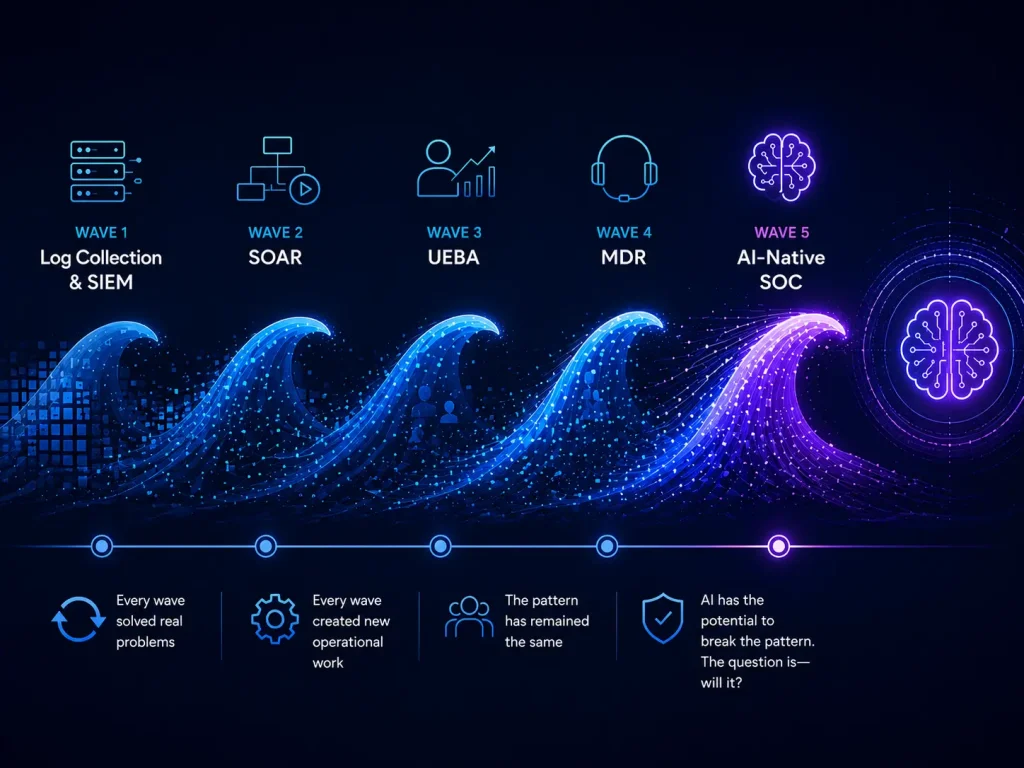
Five Automation Waves in the SOC and The Pattern the AI Wave Has Not Broken Yet
Every wave of security operations automation has promised the same thing: less work and faster response for security teams. Every wave has delivered genuine innovation.…
Read article
The Economics Behind Every AI SOC
AI SOCs promises predictable security outcomes. Faster investigations. Lower analyst workloads. Quicker response. Better resilience. Behind every fixed-price managed service, however, sits a variable that…
Read article