
How AI Triage Ends Alert Fatigue in the SOC
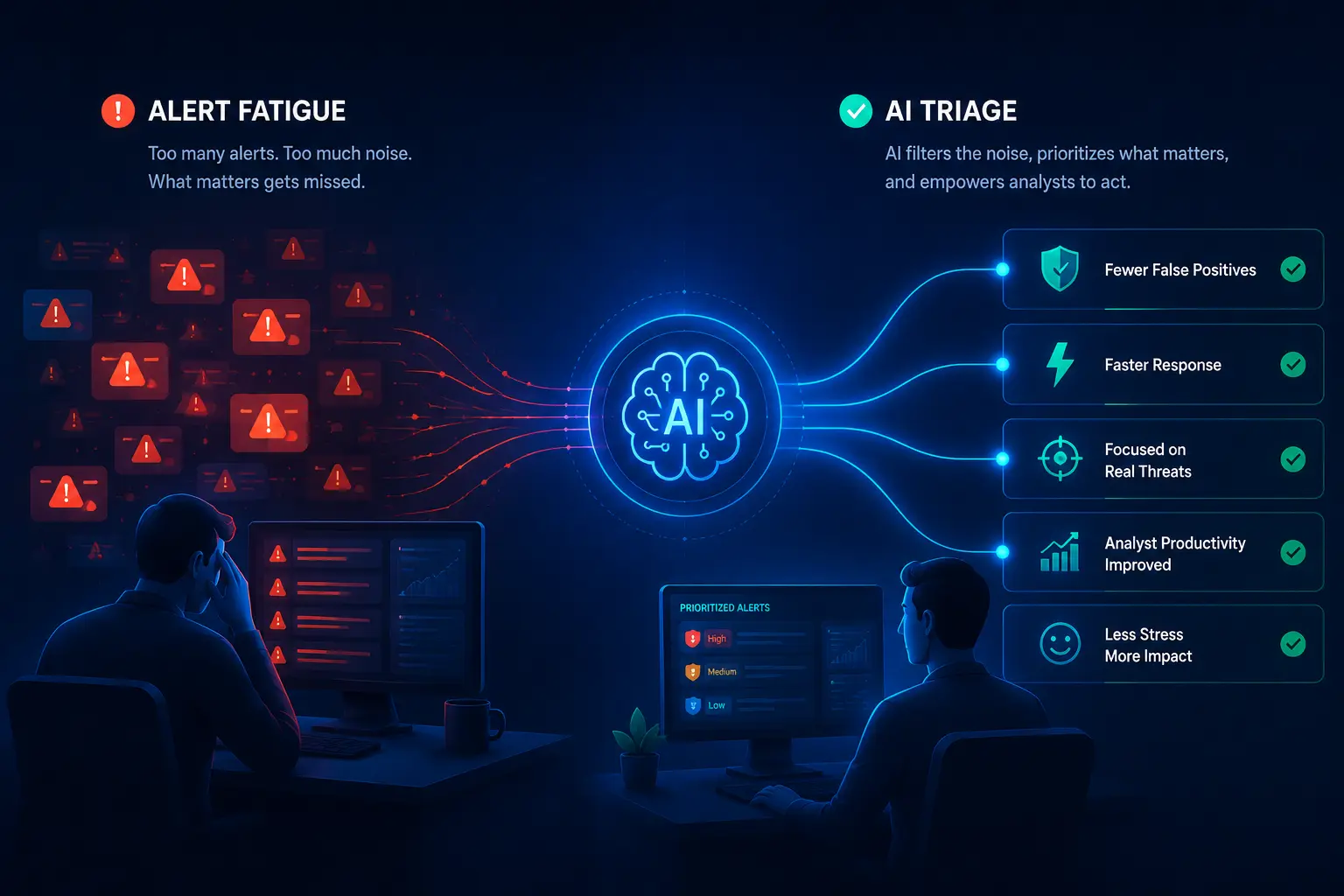
Alert fatigue is the desensitisation that sets in when security analysts face more alerts than any team can realistically investigate, causing genuine threats to be missed amid a flood of noise. AI alert triage solves this by automatically enriching, correlating, and scoring every alert, then closing benign events within defined guardrails and escalating only the incidents that warrant human attention. The result is a security operations centre (SOC) that spends its time on real risk rather than on repetitive, low-value review. This article explains what causes alert fatigue, what it costs, and how AI-driven triage changes the economics of detection and response.
What is alert fatigue and why does it happen?
Alert fatigue describes the cognitive and operational state in which analysts are exposed to such a high volume of security alerts that they can no longer respond to each one with full attention. Modern security stacks generate signals from endpoints, identity providers, firewalls, cloud workloads, email gateways, and SaaS applications. Each tool produces its own alerts, often with little shared context, and a large share of those alerts are benign or duplicate.
The underlying causes are structural rather than accidental:
- Alert overload from tool sprawl. Every new detection source adds volume without reducing it, and overlapping rules raise the same event multiple times.
- High false positive rates. Detection rules tuned for sensitivity inevitably flag legitimate behaviour, and conservative thresholds err towards raising alerts rather than suppressing them.
- Missing context. A raw alert rarely tells the analyst whether the user is privileged, whether the asset is critical, or whether the activity matches a known pattern. Gathering that context manually is slow.
- Round-the-clock demand. Threats do not respect business hours, so the queue never empties and the backlog compounds across shifts.
What does alert fatigue cost the SOC?
The cost of alert fatigue is paid in two currencies: missed threats and SOC analyst burnout. When every alert looks like the last one, the rare signal that matters is easily dismissed as another false positive. Attackers depend on exactly this dynamic, deliberately generating activity that blends into routine noise so that initial access or lateral movement passes unremarked.
The human cost is equally damaging. Repetitive, low-judgement work erodes morale, and SOC analyst burnout drives turnover in a discipline where experienced practitioners are already scarce. Each departure removes institutional knowledge and increases the load on those who remain, deepening the cycle. For security leaders, the consequences are concrete: slower mean time to respond, inconsistent handling between shifts, and a growing backlog that obscures the genuine incidents buried within it.
Regulatory expectations sharpen the stakes. Under the EU’s NIS2 Directive, adopted in 2022, and the Digital Operational Resilience Act (DORA), which applies from 17 January 2025, organisations must demonstrate timely detection, handling, and reporting of incidents. A queue too large to triage reliably is a compliance liability as much as a security one.
How does AI alert triage work?
AI alert triage applies machine reasoning to the first-line work that traditionally consumes analyst time. Rather than presenting raw alerts to a person, the system performs the investigative steps an experienced analyst would take, in seconds and at scale. The process moves through distinct stages.
Automatic enrichment
The moment an alert arrives, the system gathers the context needed to assess it: the identity and privilege level of any user involved, the criticality and ownership of the asset, recent related activity, threat intelligence on observed indicators, and the historical behaviour baseline for that entity. This enrichment removes the manual lookups that slow human triage.
Correlation
Individual alerts are linked across sources and time. A single suspicious sign-in may be unremarkable; the same sign-in followed by privilege escalation and unusual data access forms a coherent attack narrative. Correlation collapses many fragmented alerts into a smaller number of investigations, mapped where relevant to adversary techniques in frameworks such as MITRE ATT&CK.
Scoring and prioritisation
Each correlated case receives a severity and confidence score based on the enriched evidence. Scoring reflects business context, so an alert affecting a critical system or a privileged account is weighted accordingly. Analysts then see a ranked queue of what matters most, not an undifferentiated list.
Auto-closing benign alerts within guardrails
Where the evidence clearly indicates benign activity, the system resolves the alert automatically and records its reasoning for audit. As an industry trend, autonomous triage can resolve the large majority of benign, low-risk alerts in this way, which is where the relief from alert overload comes from. Crucially, auto-closure operates within explicit guardrails: defined confidence thresholds, scope limits, and exclusion rules ensure that anything ambiguous or high-impact is escalated rather than closed.
Escalation of what matters
Cases that exceed the confidence or severity thresholds are escalated with a complete, human-readable summary: what happened, why it was flagged, the supporting evidence, and a recommended response. Analysts begin their work already informed, rather than starting each investigation from zero.
Manual triage versus AI triage
The difference between conventional first-line triage and AI-driven triage is best seen stage by stage.
| Triage stage | Manual approach | AI-driven approach |
|---|---|---|
| Enrichment | Analyst queries multiple consoles by hand | Context gathered automatically on arrival |
| Correlation | Dependent on individual memory and tooling | Alerts linked across sources and time consistently |
| Prioritisation | First-in-first-out or ad hoc judgement | Severity and confidence scored with business context |
| Benign alerts | Each reviewed and closed manually | Auto-closed within defined guardrails, fully logged |
| Consistency | Varies by analyst and shift | Uniform, repeatable, auditable |
| Analyst focus | Spread thinly across the full queue | Reserved for escalated, high-value incidents |
Key takeaways
- Alert fatigue arises from alert overload, high false positive rates, and missing context, and it leads directly to missed threats and SOC analyst burnout.
- AI alert triage enriches, correlates, scores, and prioritises every alert automatically, replacing slow manual first-line work.
- Benign, low-risk alerts are auto-closed within explicit guardrails, while only meaningful incidents are escalated to analysts.
- Reducing false positives and noise improves mean time to respond and supports NIS2 and DORA expectations for timely detection.
- The mechanism preserves human judgement for the cases that genuinely require it, addressing burnout and retention.
How AI triage reduces false positives and analyst burnout
Reducing false positives is not about suppressing detections; it is about resolving them correctly. By applying consistent enrichment and correlation to every alert, AI triage distinguishes routine behaviour from genuine threats with a uniformity no manually staffed queue can match. Noise is filtered out by evidence rather than ignored through exhaustion, which is the difference between a quieter queue and a safer one.
The effect on people is direct. When the bulk of repetitive review is handled automatically, analysts spend their time on investigation, threat hunting, and response, the work that drew them to the profession. That shift is the most durable answer to SOC analyst burnout, because it changes the nature of the role rather than merely adding capacity. For a broader view of how this fits into a modern operating model, see what an AI SOC is.
Where Vokter fits
Vokter delivers AI alert triage in two configurations suited to different operating models. Vokter Hybrid applies AI as the first line over your existing SIEM and SOAR, taking on enrichment, correlation, scoring, and the auto-closure of benign alerts within guardrails, so that your analysts are freed for higher-level L2 and L3 work. For organisations seeking to move beyond a traditional pipeline, Vokter Autonomous performs SIEM-less detection and triage end to end, escalating only what requires human decision. Both run within EU data sovereignty boundaries and apply explicit, auditable guardrails to every automated action. To discuss which configuration fits your environment, get in touch.
Conclusion
Alert fatigue is not a problem that more staff or stricter tuning can solve on their own, because the volume and inconsistency are structural. AI-driven triage addresses the root cause by performing first-line investigation automatically, resolving benign alerts within guardrails, and escalating only what matters. In doing so it reduces false positives, lowers mean time to respond, and returns skilled analysts to the work that requires human judgement.
Frequently asked questions
What is alert fatigue in a SOC?
How does AI alert triage reduce false positives?
Is it safe for AI to auto-close alerts?
How does AI triage help with SOC analyst burnout?
What is the difference between Vokter Hybrid and Vokter Autonomous for triage?
More insights

The Tempo of Modern Security Operations
What’s inside Security operations are no longer defined simply by how many alerts a team handles or how many tools it runs. They are increasingly…
Read article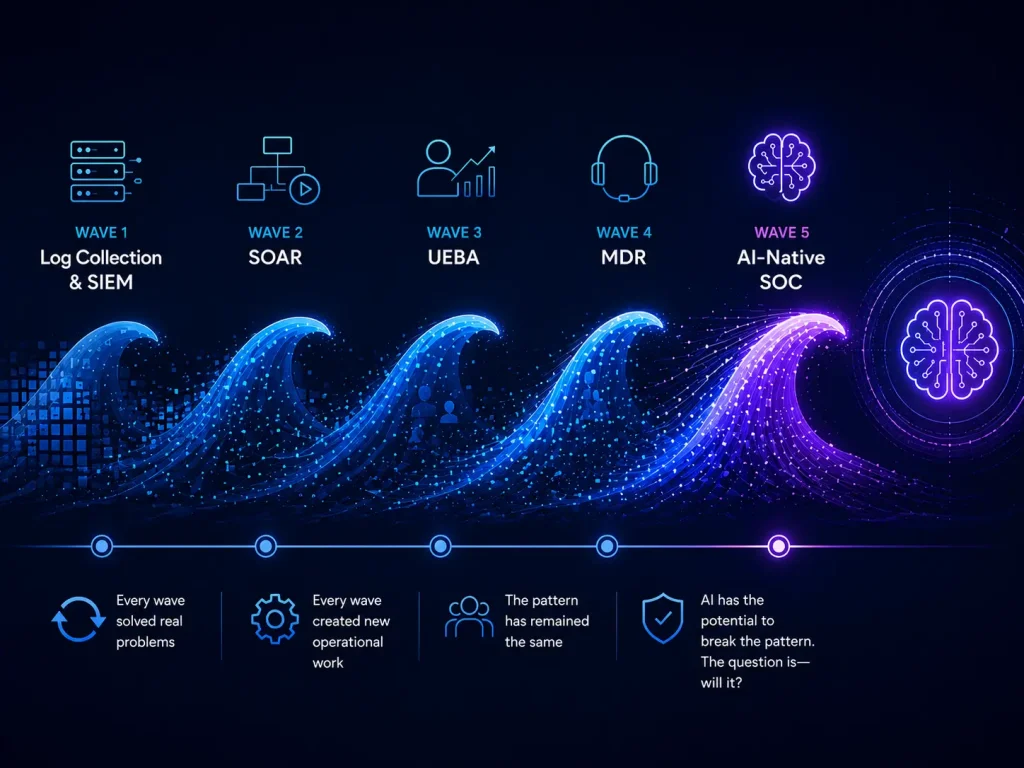
Five Automation Waves in the SOC and The Pattern the AI Wave Has Not Broken Yet
Every wave of security operations automation has promised the same thing: less work and faster response for security teams. Every wave has delivered genuine innovation.…
Read article
The Economics Behind Every AI SOC
AI SOCs promises predictable security outcomes. Faster investigations. Lower analyst workloads. Quicker response. Better resilience. Behind every fixed-price managed service, however, sits a variable that…
Read article