
How to Get 24/7 SOC Coverage Without a Night Shift

To achieve 24/7 SOC coverage without running a night shift, route first-line detection and triage to an AI SOC that operates continuously, then escalate only confirmed, prioritised incidents to your people during working hours or to a managed analyst team under an SLA. The AI handles the relentless overnight volume; humans handle judgement. This gives a lean security team genuine round-the-clock protection without recruiting, training and retaining staff across multiple shifts.
Attackers do not keep office hours. Ransomware deployment, credential abuse and lateral movement are frequently timed for evenings, weekends and public holidays precisely because that is when defenders are thin. The practical question for most mid-market organisations is not whether they need after-hours security monitoring, but how to fund and sustain it.
Key takeaways
- True 24/7 SOC coverage requires multiple shifts, holiday and sickness cover, and continuous training, which is difficult for a lean security team to staff in-house.
- The realistic options are building in-house, follow-the-sun arrangements, outsourcing to MDR or SOC-as-a-service, and AI-led continuous monitoring, each with distinct trade-offs.
- An AI SOC provides continuous first-line detection and triage, so a small team is no longer the bottleneck for round-the-clock coverage.
- Vokter Autonomous delivers continuous coverage with no in-house team; Vokter Guardian adds named Nordic analysts on a 24/7 SLA.
- The strongest models combine automation for first response with human escalation for judgement, containment decisions and forensics.
Why 24/7 SOC coverage is so hard to staff
Continuous monitoring sounds like a scheduling problem. It is closer to a workforce problem. Covering every hour of every day means operating several rotating shifts, then layering cover on top for annual leave, sickness, training and inevitable attrition. Night and weekend rotations are unpopular, burn analysts out faster, and intensify the well-documented shortage of experienced security staff.
The hidden cost is quality. Overnight shifts often see the least experienced analysts facing the highest-stakes alerts with the least support. Alert fatigue compounds the problem: when a tired analyst is wading through thousands of low-value notifications, genuine threats are easy to miss. This is why so many lean teams technically have after-hours security monitoring on paper, yet still discover breaches days later.
The options for round-the-clock SOC coverage
There are four broad routes to continuous coverage. Most organisations end up combining them rather than choosing one outright.
| Option | How it works | Best suited to | Key trade-off |
|---|---|---|---|
| Build in-house | Recruit enough analysts to staff continuous shifts internally | Large enterprises with deep budgets and existing SOC maturity | Highest cost; hardest to staff and retain across night and weekend rotations |
| Follow-the-sun | Hand off monitoring between teams in different time zones | Multinational organisations with offices across regions | Requires distributed teams and tight handover discipline; rarely viable for a single-country mid-market firm |
| Outsource to MDR / SOC-as-a-service | A provider supplies analysts, tooling and processes as a service | Teams that want human coverage without building it themselves | Coverage and data residency vary by provider; you depend on their staffing and response quality |
| AI SOC | Automation performs continuous detection, triage and investigation, escalating to humans | Lean teams needing genuine 24/7 coverage without a night shift | Requires confidence in autonomous handling; works best with a human escalation path |
Building in-house and follow-the-sun both assume scale that most Nordic and DACH mid-market organisations simply do not have. That leaves outsourcing and automation as the realistic levers, and increasingly the two are combined. For a fuller comparison of the managed route, see our guide to SOC-as-a-service in the Nordics and an overview of what MDR is.
How an AI SOC delivers 24/7 SOC coverage without a night shift
An AI SOC changes the economics of continuous coverage because the system that watches your environment overnight is not a person on a rota. It ingests telemetry, correlates signals, investigates suspicious activity and triages alerts continuously, at a volume and consistency no shift pattern can match. Crucially, it does not get tired at 03:00, and it applies the same investigative rigour at every hour.
This directly attacks the SOC staffing problem. Instead of needing analysts present around the clock, you need them available to act on the small number of confirmed, contextualised incidents the AI escalates. The overnight noise that drives alert fatigue is resolved before anyone is woken. To understand how this works in practice, see how AI handles alert triage and alert fatigue.
Good automation is transparent about what it did and why. Each escalation should arrive with the evidence, the investigative steps taken and a recommended action, so the receiving human can make a fast, informed decision rather than starting an investigation from scratch.
Where humans still matter
Automation is not a replacement for judgement. Decisions about disruptive containment, communication with leadership, regulatory notification and deep forensic analysis benefit from human expertise. The honest position is that an AI SOC is exceptional at first-line coverage and triage, and humans remain essential for the complex, high-consequence end of incident response. A well-designed service makes the handoff between the two seamless.
Choosing between no team and a hybrid analyst model
Two configurations suit lean teams needing round-the-clock SOC coverage, and the right one depends on whether you want any in-house involvement at all.
Vokter Autonomous provides continuous, SIEM-less detection and response with no in-house SOC team required. It is built for organisations that have neither the staff nor the appetite to run security operations themselves, but still need genuine 24/7 protection. The AI performs first-line monitoring around the clock and surfaces only what matters.
Vokter Guardian pairs that same continuous AI coverage with named Nordic analysts available 24/7 under a contractual SLA. The AI handles the large majority of detection and triage; experienced analysts provide threat hunting, forensics and escalation support, with defined response commitments. This is the model for teams that want automation to carry the overnight load while retaining human accountability and a guaranteed response.
If you are weighing providers, our guidance on choosing an AI SOC provider in Europe sets out the questions worth asking. When you are ready to discuss coverage for your environment, get in touch.
What to look for in after-hours security monitoring
- Genuine continuity, not on-call. Confirm that monitoring is truly continuous, not a pager that wakes someone who then logs in.
- Clear escalation paths. Know exactly what is handled autonomously, what is escalated, and how quickly.
- Contextualised alerts. Every escalation should carry the evidence and reasoning, not just a notification.
- Defined response commitments. An SLA turns “we monitor 24/7” into a measurable obligation.
- EU data sovereignty. For Nordic and EU organisations, telemetry should remain within EU cloud regions under EU jurisdiction, which also supports obligations under NIS2 and DORA.
Conclusion
Round-the-clock protection no longer depends on filling a night-shift rota. By routing continuous first-line detection and triage to an AI SOC and reserving human expertise for genuine incidents, a lean security team can achieve 24/7 SOC coverage that is consistent, sovereign and sustainable. Whether you choose continuous coverage with no in-house team or an AI-plus-analyst model under an SLA, the night shift is no longer the price of staying protected after dark.
You have endpoint detection, a SIEM, identity monitoring, email security and 24/7 coverage. You made the investments and checked the boxes — and investigations still take too long, analysts are still buried, and the tools still do not quite talk to each other. The instinct is to question the stack. Usually the stack is fine. The failure is in the operational layer that is supposed to tie it together — the Level 1 work — and that layer is exactly what an AI-native SOC automates.
Key takeaways
- A decade of security budget went to detection tools and almost none to the operations that connect detection to response.
- Each tool sees only part of an attack; the truth is in the correlation across them, and a human is usually the slow, lossy integration layer.
- Neither the SIEM (a data problem) nor SOAR (known playbooks) closes the gap; both still assume a human investigates.
- An operational layer that automates L1 — correlation, investigation, first-line response — closes it without replacing your stack.
The real failure point is not detection
Detection is rarely where modern security operations fail. Your tools surface plenty; the industry’s problem was never a shortage of alerts. The breach happens in the gap between detection and response — the window where an alert sits in a queue, gets a partial look, loses context at a hand-off, and waits for someone to connect it to the two related signals sitting in other consoles. That gap is measured in dwell time, and dwell time is an operations metric, not a detection one. No additional detection product shortens it.
The seam problem, with a real example
Every tool has a partial view, and attackers move across the seams between them. Consider a realistic account-takeover sequence:
- Your identity provider flags an unusual sign-in — new country, but the session passes MFA. On its own: low severity, plausibly a travelling employee.
- Minutes later, your email security notes a new inbox rule auto-forwarding finance mail to an external address. On its own: medium, and rules get created all the time.
- Your cloud logs record an OAuth token grant to a third-party app. On its own: low, users grant app access constantly.
Three tools, three unremarkable alerts, each easily auto-closed in isolation. Correlated, they are a textbook account takeover in progress. The signal was never in any single tool — it was in the relationship between them, in a tight time window, tied to one identity. A human can absolutely see this, if a human happens to look at all three consoles in the same ten minutes and remembers the first alert while reading the third. Under real queue pressure, that is exactly what does not happen.
Why the SIEM didn’t fix this
The SIEM was supposed to solve exactly this by centralising the data — and it solved the data problem. But centralising logs is not the same as operationalising them. Someone still has to author and tune the correlation rules, keep them current as the environment changes, and then investigate what they surface. In practice the SIEM often becomes an expensive, noisy data lake that raises more alerts than anyone trusts. The data is in one place; the operations are still manual.
Why SOAR didn’t fix it either
SOAR promised automation, and it delivers — for the cases you can write down in advance. A playbook is superb at executing a known response: this alert, these steps, in this order. But a playbook cannot investigate a situation nobody pre-scripted, and it breaks when reality diverges from the runbook. SOAR automates the response to the known; it does not automate the investigation of the unknown, which is the part that actually consumes L1.
The missing operational layer
What has been missing is a layer above the stack that does the connective, investigative work automatically — the work SOCs staff with L1 analysts. An AI-native SOC continuously correlates telemetry across identity, endpoint, cloud, email and network; maintains investigative context across an incident instead of losing it at every hand-off; enriches and scores each case; resolves or safely contains the clear ones; and surfaces only what needs a human — with the investigation already assembled. In the takeover example above, that layer sees all three signals against one identity in one window and raises a single, high-confidence case while the attack is still early. It is also what ends alert fatigue, because analysts stop wading through the noise the layer has already resolved.
Escalation-based MDR vs an operational layer
| Dimension | Traditional / escalation MDR | AI-native operational layer |
|---|---|---|
| What you receive | Alerts to investigate | Verdicts and outcomes |
| Cross-tool correlation | Left to your team | Automatic, every case |
| Investigative context | Rebuilt per hand-off | Maintained across the incident |
| Unknown scenarios | Human-dependent | Investigated on their merits |
| Your existing stack | Often duplicated or replaced | Kept and coordinated |
| Primary output | Reduced detection gaps | Reduced detection-to-response gap |
What fixing it looks like — your stack stays
Closing this gap does not mean ripping anything out. Sentinel, Splunk, CrowdStrike, Defender, Okta — they stay exactly where they are. What changes is the layer above them: alerts start arriving with cross-tool context already attached, investigations stop fragmenting across six consoles, and response timelines compress — not because you hired more analysts, but because the connective work that was slowing everything down now runs automatically and continuously. This is the outcome that separates real managed detection and response from monitoring that simply escalates, and it is how you get genuine 24/7 coverage without a night-shift rota.
“But we already have MDR / SOAR”
Two fair objections. First: we have an MDR. Most MDR is escalation-based — it detects and hands you alerts, leaving the correlation and response to you; the seam problem survives it. Ask whether yours delivers alerts or outcomes. Second: we have SOAR. SOAR is valuable for automating known response steps, but it executes playbooks; it does not investigate the unscripted, and the account-takeover sequence above is precisely the kind of emergent case no playbook was written for. An operational layer complements both — it is the investigative first line that turns your detections and your playbooks into decisive action.
Close the gap with Vokter
Vokter is that operational layer. It sits on top of the stack you already run and automates the Level 1 first line — cross-tool correlation, investigation to a verdict, and safe first-line response — so detection finally turns into action. Add it over your existing SIEM/XDR with Vokter Hybrid, run it as your whole first line with Vokter Autonomous, or add named Nordic analysts and an SLA with Vokter Guardian — operated within EU jurisdiction throughout. Find out what is slipping through the seams.
Frequently asked questions
How can a small team get 24/7 SOC coverage without a night shift?
Why is staffing a 24/7 SOC in-house so difficult?
What are the options for round-the-clock SOC coverage?
Can an AI SOC handle overnight coverage on its own?
What is the difference between Vokter Autonomous and Vokter Guardian for after-hours coverage?
More insights

The Tempo of Modern Security Operations
What’s inside Security operations are no longer defined simply by how many alerts a team handles or how many tools it runs. They are increasingly…
Read article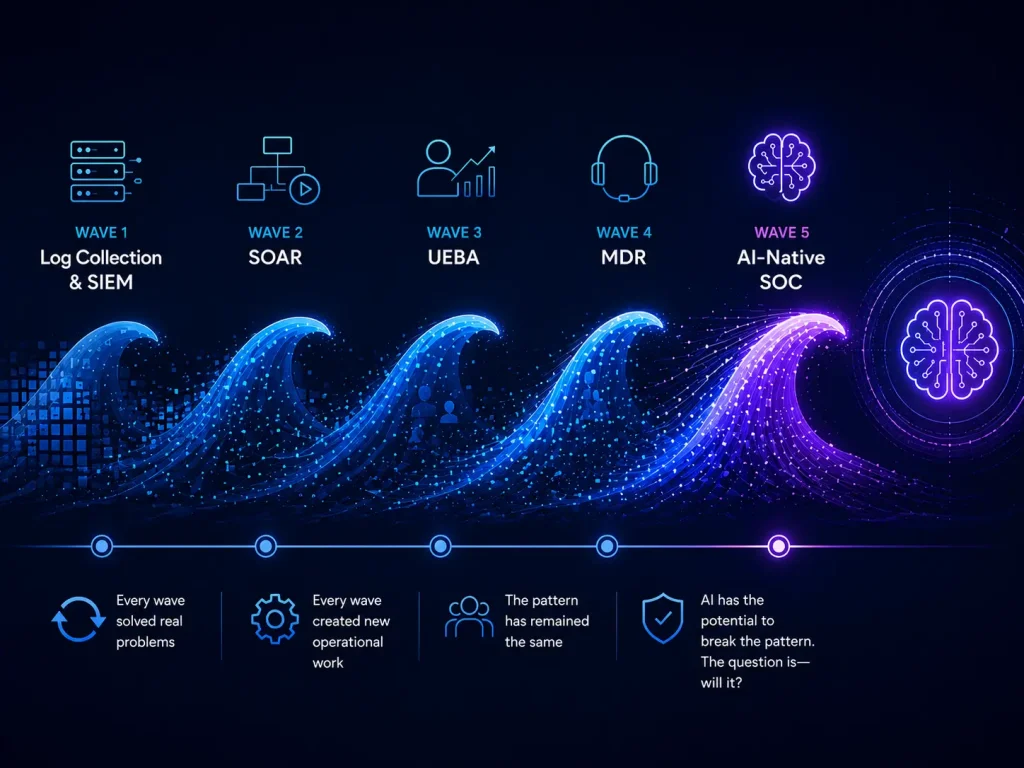
Five Automation Waves in the SOC and The Pattern the AI Wave Has Not Broken Yet
Every wave of security operations automation has promised the same thing: less work and faster response for security teams. Every wave has delivered genuine innovation.…
Read article
The Economics Behind Every AI SOC
AI SOCs promises predictable security outcomes. Faster investigations. Lower analyst workloads. Quicker response. Better resilience. Behind every fixed-price managed service, however, sits a variable that…
Read article