OT Security in the Nordics: AI SOC for Manufacturing
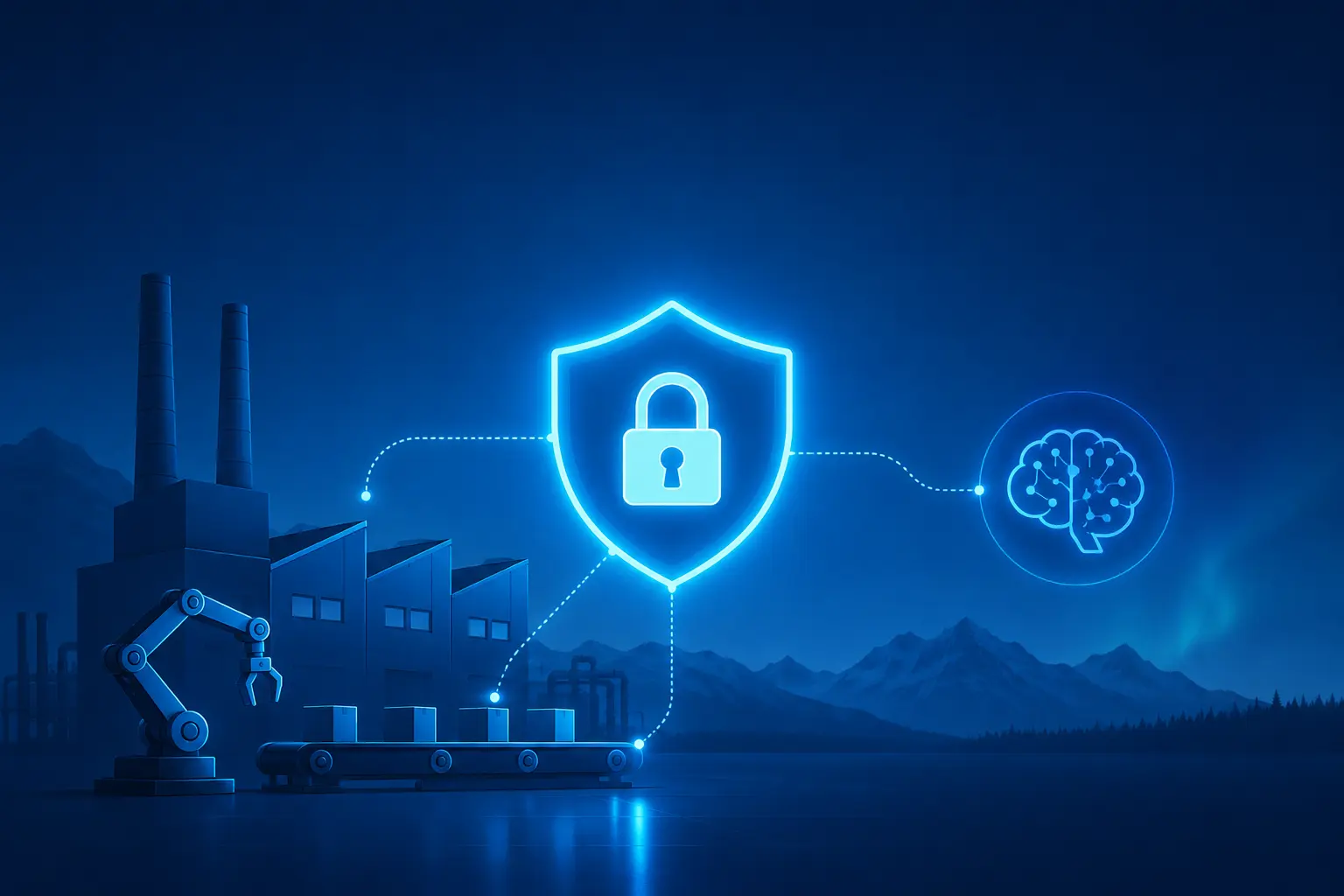
OT security in the Nordics has become a board-level concern as the region’s manufacturers, energy operators, and industrial firms connect once-isolated plant systems to corporate networks and the internet. Operational technology (OT) controls physical processes, so a security incident can halt production or threaten safety, not just leak data. An AI SOC helps Nordic manufacturers by providing continuous, around-the-clock monitoring of both IT and OT environments and responding to threats in a safe, bounded, reversible way that respects the sensitivity of industrial control systems.
This article examines the OT threat landscape, why IT/OT convergence raises risk, where traditional IT SOCs struggle with industrial environments, what effective OT monitoring requires, the regulatory pressure facing Nordic industry, and how an AI SOC delivers coverage suited to safety-critical operations.
Key takeaways
- OT security in the Nordics matters because industrial control systems govern physical processes, so incidents can disrupt production or affect safety, not merely compromise information.
- IT/OT convergence improves efficiency but expands the attack surface, exposing legacy control systems that were never designed to be networked or patched frequently.
- Traditional IT SOCs often struggle with OT because they lack protocol awareness, asset context, and an appreciation of availability and safety constraints.
- OT monitoring favours passive, non-intrusive techniques, asset discovery, and a clear view of the Purdue model levels rather than aggressive active scanning.
- NIS2 brings many manufacturing and critical entities into scope as essential or important entities, raising expectations for monitoring and incident reporting.
- An AI SOC provides continuous coverage with bounded, verified, reversible response, with expert oversight available through Vokter Guardian for sensitive environments.
Why does OT security in the Nordics matter now?
The Nordic region has a deep industrial base: pulp and paper, mining and metals, automotive and machinery, chemicals, food production, shipping, and a large energy sector spanning hydro, nuclear, wind, and oil and gas. These sectors depend on operational technology, the industrial control systems, programmable logic controllers, and supervisory systems that run physical processes on the factory floor and across distributed sites.
For most of their history, these systems were air-gapped or run on proprietary networks, which limited exposure. That isolation is eroding. Digitalisation, remote maintenance, predictive analytics, and tighter integration between the plant floor and enterprise IT have connected OT to networks that attackers can reach. The consequence is that OT security Nordics teams now face threats that were once confined to IT, but with far higher stakes: a successful intrusion can stop a production line, damage equipment, or, in the worst case, create a safety hazard.
The OT threat landscape for manufacturing cybersecurity
Manufacturing cybersecurity has distinctive risks. The threats are not only the familiar ransomware and intrusion campaigns that target enterprise IT, but also attacks that exploit the specific weaknesses of industrial environments.
- Ransomware crossing into production. Attacks that begin in IT can spread to systems that manage or interface with the plant floor, forcing operators to halt production as a precaution even when OT itself is not directly encrypted.
- Legacy and unpatched systems. Control systems often run for decades on operating systems and firmware that can no longer be patched easily, or at all, without risking process disruption.
- Remote access exposure. Vendor and engineer remote access, necessary for maintenance, can become an entry point if it is not tightly monitored and controlled.
- Insider and supply-chain risk. Compromised maintenance laptops, removable media, and third-party integrations can introduce threats that bypass perimeter defences.
- Living-off-the-land techniques. Attackers increasingly use legitimate tools and protocols, which makes malicious activity harder to distinguish from normal engineering work.
What unifies these risks is consequence. In IT, the primary concern is confidentiality and integrity of data. In OT, availability and safety come first, because the systems govern physical reality.
IT/OT convergence: efficiency that expands the attack surface
IT/OT convergence describes the merging of corporate information technology with operational technology, so that plant data flows into enterprise analytics and business systems can reach into production. It delivers real benefits: better visibility of operations, predictive maintenance, and faster decision-making. It also expands the attack surface considerably.
Convergence means that a foothold in IT can become a path into OT, and that systems never designed for internet exposure are now reachable through connected networks. Many control systems lack basic security controls such as authentication or encryption, because they were built for trusted, isolated environments. When those systems are bridged to IT, their weaknesses become enterprise risks. Effective security therefore requires monitoring that spans both domains and understands the boundaries between them, rather than treating IT and OT as separate, unrelated problems.
Why traditional IT SOCs struggle with industrial control systems security
A conventional IT SOC is built around enterprise telemetry: endpoints, servers, identity, cloud, and corporate network traffic. Pointed at an industrial environment, it frequently falls short for several reasons related to industrial control systems security.
- Protocol blindness. OT uses specialised protocols that general-purpose IT tooling may not parse, so malicious or anomalous control-system traffic goes unseen.
- Lack of asset context. Without an accurate inventory of controllers, sensors, and engineering stations, alerts lack the context needed to judge severity and impact.
- Wrong priorities. IT response often defaults to isolating or shutting down affected systems. In OT, an abrupt shutdown can itself cause a safety or production incident, so that reflex can do more harm than the threat.
- Intrusive scanning. Active vulnerability scans that are routine in IT can disrupt fragile control devices, so they are often unsafe in production OT.
- Alert overload without tuning. Industrial environments generate distinctive traffic patterns; an IT SOC that is not tuned for them produces noise that buries genuine threats.
The table below summarises the core differences security leaders need to account for.
| Dimension | Traditional IT security | OT security |
|---|---|---|
| Primary priority | Confidentiality and integrity of data | Availability and safety of physical processes |
| Acceptable downtime | Patching and reboots routinely scheduled | Downtime costly or hazardous; change tightly controlled |
| System lifespan | Years; refreshed regularly | Decades; legacy systems common |
| Patching | Frequent, often automated | Infrequent; may be impossible without disruption |
| Monitoring approach | Active scanning acceptable | Passive, non-intrusive monitoring preferred |
| Protocols | Standard IT protocols | Specialised industrial protocols |
| Response to threat | Isolate or shut down quickly | Bounded, reversible action; avoid unsafe shutdown |
What effective OT monitoring requires
Monitoring an OT environment well means respecting its constraints. The starting point is visibility: a reliable, continuously updated inventory of assets and the connections between them. Because active scanning can be unsafe, OT monitoring favours passive, non-intrusive techniques that observe network traffic without injecting packets into fragile devices. This allows the SOC to learn what normal looks like and to flag deviations without touching the process itself.
A useful frame is the Purdue model, which describes industrial architectures in layered levels, from physical process and field devices at the lowest levels, through control and supervisory systems, up to manufacturing operations and, at the top, enterprise IT. Effective monitoring pays particular attention to the boundary between the enterprise and operations zones, where IT and OT meet, because that is where convergence-driven threats most often cross. Detection content should be aware of these levels, so that an alert can be interpreted in terms of where it sits and what it could affect.
Above all, OT monitoring must connect anomalies to operational meaning. An unexpected command to a controller, an unfamiliar device on a control network, or a deviation in expected traffic patterns matters because of what it could do physically, and a capable OT SOC treats it accordingly.
Regulatory pressure: NIS2 and the Nordic industrial base
Regulation is sharpening expectations for OT security across Nordic industry. The NIS2 directive, adopted in 2022, brings many manufacturing and critical-infrastructure entities into scope as essential or important entities, with obligations covering risk management, incident detection and handling, supply-chain security, and structured incident notification to national authorities. Sectors such as energy, water, food production, and the manufacture of certain products are squarely within its reach, which means that monitoring and reporting can no longer be treated as optional for industrial operators.
Because NIS2 is a directive, member states transpose it into national law, and the precise classifications and reporting timeframes vary by country, so Nordic operators should confirm their obligations under each relevant national regime. For organisations with financial-sector ties, DORA, which applies from 17 January 2025, adds further operational-resilience and reporting expectations. A practical way to assess readiness is to work through a structured NIS2 SOC checklist and map each obligation to your current monitoring and response capability.
How an AI SOC delivers continuous, safe OT coverage
An AI SOC is well suited to the demands of industrial environments because it combines continuous coverage with response that is deliberately bounded and reversible. The hardest part of OT security is being everywhere, all the time, without taking actions that could disrupt a live process. AI-driven monitoring watches IT and OT telemetry continuously, triages alerts to separate genuine threats from operational noise, and reconstructs the context of an event so that severity and potential physical impact can be judged quickly. That continuous, automated triage is what makes round-the-clock coverage realistic without an unsustainable analyst rota.
Crucially for OT, every action an AI SOC takes is designed to be safe. At Nordic SOC, all automated response is bounded, verified, and reversible, so the system does not reflexively shut down or isolate a control system in a way that could itself cause harm. Safe autonomous containment favours measured, reversible steps and clear escalation over blunt intervention, which is exactly the posture sensitive industrial environments require.
For Nordic manufacturers, two Vokter modes fit the OT context particularly well. Vokter Guardian pairs AI, which handles the large majority of routine detection and triage, with named Nordic analysts providing 24/7 oversight, threat hunting, forensics, and a contractual SLA. That expert oversight is valuable where the consequences of error are physical and where containment decisions need human judgement. Where an organisation has limited existing tooling and wants rapid coverage, Vokter Autonomous provides AI-driven monitoring and response without requiring a SIEM, drawing on EDR, XDR, or Windows Event Collector telemetry. As an independent, EU-sovereign provider holding data in EU cloud regions, Nordic SOC keeps monitoring and evidence within European jurisdiction, which matters for both regulatory alignment and the protection of sensitive operational data.
If you would like to discuss how continuous, safe OT monitoring would fit your environment, contact Nordic SOC.
Conclusion
OT security has moved from a peripheral concern to a central one for Nordic manufacturers, as connected operations expose systems that were never built to be networked and as regulation raises the bar for monitoring and reporting. The defining requirement is coverage that is both continuous and safe: always watching, but never acting in a way that could disrupt a physical process. An AI SOC, with bounded and reversible response and expert oversight where it is needed, gives industrial operators a realistic way to meet that requirement across converged IT and OT environments.
Frequently asked questions
Can an AI SOC safely monitor OT environments?
What is the difference between IT security and OT security?
What is IT/OT convergence and why does it raise risk?
Why do traditional IT SOCs struggle with OT environments?
Does NIS2 apply to manufacturing in the Nordics?
More insights

The Tempo of Modern Security Operations
What’s inside Security operations are no longer defined simply by how many alerts a team handles or how many tools it runs. They are increasingly…
Read article
Five Automation Waves in the SOC and The Pattern the AI Wave Has Not Broken Yet
Every wave of security operations automation has promised the same thing: less work and faster response for security teams. Every wave has delivered genuine innovation.…
Read article
The Economics Behind Every AI SOC
AI SOCs promises predictable security outcomes. Faster investigations. Lower analyst workloads. Quicker response. Better resilience. Behind every fixed-price managed service, however, sits a variable that…
Read article