
Automating the L1 SOC Analyst: The Work, the Failure Modes, and What AI Actually Fixes

Most conversations about “automating the SOC” start in the wrong place — with the technology. Start instead with the job. The Level 1 (L1) analyst runs a specific, well-defined decision procedure hundreds of times a shift. Understanding that procedure — and the conditions under which humans are forced to run it — explains exactly why it is the right thing to automate first, and why automating it is less about intelligence than about removing the conditions that make good analysts perform badly.
Key takeaways
- L1 is a decision procedure: given an alert, reach a verdict (true or false positive) and decide whether it warrants escalation.
- Humans do not fail at L1 because they lack skill; they fail because volume, base-rate neglect, alarm habituation and shift handovers degrade judgement predictably.
- Automation wins by removing those conditions — running the same enrichment and correlation in seconds, statelessly consistent, around the clock — not by being “smarter” than an analyst.
- The design that matters escalates on uncertainty; a high auto-close rate is a vanity metric, escalation precision and recall are the real ones.
What L1 actually decides
Strip away the tooling and an L1 analyst answers two questions for every alert: is this a true positive? and does it warrant escalation? Everything else — opening the ticket, pivoting between consoles, copying an IP into a threat-intel lookup, checking whether a process is a known admin script — is the evidence-gathering that supports those two answers. The valuable output of L1 is not a forwarded alert; it is a verdict with evidence. An escalation that arrives at L2 as “EDR fired on host X, take a look” has done none of the work. One that arrives as “credential theft attempt on a finance workstation, here is the process tree, the identity’s anomalous sign-in ten minutes earlier, and why this is not the backup job that usually triggers this rule” has done all of it.
This matters because it reframes the automation question. You are not asking a machine to be creative. You are asking it to execute a known procedure reliably at a volume and cadence humans cannot sustain.
Why good analysts still miss things
The uncomfortable part: the misses are not a training problem. They are structural, and they are predictable.
Base-rate neglect under a flood of false positives
When the overwhelming majority of alerts are benign, the human prior quietly shifts toward “this is nothing too.” That is rational as a shortcut and dangerous as a habit — it is precisely how the one real alert in a thousand gets a cursory glance and a close.
Alarm habituation
The same noisy rule firing forty times a day trains the analyst to dismiss it on sight. Attackers who understand this deliberately operate inside the noise, using techniques that resemble routine administrative activity.
Context-switching cost
Each alert lives across several consoles — EDR, identity provider, email security, the SIEM. Reassembling context for every ticket is expensive, and under queue pressure the reassembly gets shorter, which is another word for shallower.
Lost state at handover
An investigation half-formed at the end of a shift rarely survives the handover intact. The night analyst inherits a queue, not a train of thought, and the thread is quietly dropped.
None of these are solved by hiring a better analyst; a better analyst degrades the same way, just later in the shift. This is the case for automation that most vendor material skips: the argument is not that AI out-thinks humans, but that it does not habituate, does not neglect base rates, does not lose state at 3am, and does not get shallower under load.
The anatomy of a single triage
Make it concrete. An EDR alert fires: WINWORD.EXE has spawned rundll32.exe, which has made an outbound connection. In isolation this is a medium-severity alert that could be a macro-based loader — or could be a legitimate add-in. A competent triage runs roughly like this:
- Enrich: pull the full process tree, the signing status of the invoked DLL, the destination reputation, the user, and the asset’s role. Is this a developer’s machine or a finance controller’s?
- Correlate: did anything else happen around this host or identity in the same window — a new inbox rule, a token grant, an impossible-travel sign-in, another endpoint firing the same pattern?
- Compare to baseline: is this the known monthly reporting macro that always trips this rule, or is it new for this user?
- Verdict: true or false positive, with the evidence attached, and a decision to auto-resolve, contain, or escalate.
Every step is mechanical. It requires access and diligence, not insight. That is the signature of work that should be automated — and note that the single most decisive step, correlation, is exactly the step a human under load is most likely to skip, because it means leaving the current console.
What automation actually changes — and what it doesn’t
An AI-native SOC runs that entire procedure on every alert, in seconds, with identical rigour on the first alert of the day and the four-hundredth. It ingests and normalises the alert, reconstructs the process and identity context, correlates against every other signal in the window, compares to baseline, and reaches a verdict with evidence. Clear low-risk cases resolve automatically; clear malicious ones can be contained within guardrails; everything ambiguous escalates — to a human, with the investigation already done.
What it does not change is who owns judgement. It does not invent intent, it does not overrule policy, and — critically — it does not pretend to certainty it lacks. The correct design treats uncertainty as an output: a novel technique or a genuinely ambiguous case becomes an escalation, not a confident auto-close. A system tuned instead to maximise its auto-close rate is optimising the one number that can hide missed detections, and that is the failure mode to interrogate in any vendor demo.
Manual L1 vs automated L1
| Dimension | Human-run L1 | Automated L1 (AI-native) |
|---|---|---|
| Time per alert | Minutes to hours; grows under load | Seconds; constant under load |
| Consistency | Degrades across a shift | Identical on alert 1 and alert 400 |
| Correlation across tools | Skipped first under pressure | Performed on every case by default |
| Coverage | Requires a night-shift rota | Continuous, no rota |
| Output of an escalation | Often a forwarded alert | A verdict with assembled evidence |
| Handover state | Lost between shifts | Persistent case context |
| Failure mode | Habituation, base-rate neglect | Misclassifying novel TTPs — mitigated by escalating on uncertainty |
The metrics that matter (and the ones that mislead)
If you automate L1, measure it honestly. Auto-close rate is a vanity metric — you can make it say anything, and a high number can mean you are silently burying real incidents. The metrics that actually reflect quality are escalation precision (of what you escalate, how much is real) and escalation recall (of what was real, how much you escalated). Alongside those, track mean time to detect and respond, the false-positive close rate audited against a sampled ground truth, and dwell time. A credible provider will let you sample and re-review auto-closed cases; if a verdict cannot be explained and audited, it cannot be trusted, which is also why explainability is becoming a procurement requirement under the EU AI Act.
What stays human
Automating L1 concentrates human attention rather than removing it. High-severity incidents, business-context decisions (“yes, that unusual transfer was the acquisition, stand down”), policy exceptions, threat hunting, and any disruptive action requiring sign-off remain with people — now working from finished investigations instead of raw queues. This is the same human-on-the-loop model that keeps automated response safe: pre-approved, reversible actions, and escalation whenever the system is unsure. The analyst’s day shifts from clearing tickets to making the calls that genuinely need a human.
Automating L1 with Vokter
Vokter is Nordic SOC’s AI-native platform built to run this exact procedure as your first line — enrich, correlate, reach a verdict with evidence, resolve or safely contain the clear cases, and escalate the rest with the investigation attached. Run it as your whole first line with Vokter Autonomous, layer it over an existing SIEM/XDR stack with Vokter Hybrid so your team moves up to L2/L3, or add named Nordic analysts and an SLA with Vokter Guardian. Data and AI processing stay within EU jurisdiction throughout. Watch it triage your own alerts.
More insights

AI SOC for Manufacturing and OT Security in the Nordics
OT security Nordics has become a board-level concern as the region’s manufacturers, energy operators, and industrial firms connect once-isolated plant systems to corporate networks and the…
Read article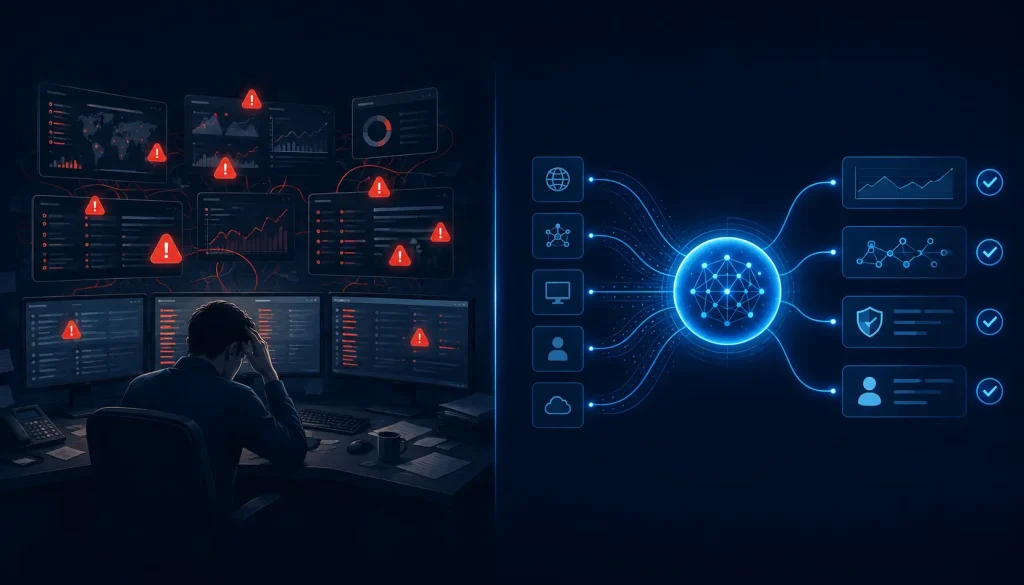
AI SOC vs Traditional SOC: What Actually Changes
An AI SOC and a traditional SOC pursue the same goal — detecting and responding to threats — but they differ in how the work…
Read article
Autonomous Containment: How AI Stops Threats Safely
Yes, AI can safely contain threats — but only when automated incident response operates inside strict guardrails. Safe containment means the system takes pre-approved, reversible actions, verifies…
Read article