
Autonomous Containment: How AI Stops Threats Safely

Yes, AI can safely contain threats but only when automated incident response operates inside strict guardrails. Safe containment means the system takes pre-approved, reversible actions, verifies every decision against rules and threat intelligence before acting, escalates high-severity cases to a human, and holds rather than guesses when it is uncertain. The trust question is not whether AI can isolate a device or block an account, but whether it does so predictably, transparently and within bounds the security team has set. This article explains how those guardrails work and why they matter under the EU AI Act.
For CISOs and SOC managers, the concern is rarely the threat itself. It is the fear that an automated system will quarantine a production server, lock out a senior executive or revoke access to a critical application at the wrong moment. A well-governed autonomous SOC is engineered specifically to prevent that.
Key takeaways
- Safe automated incident response depends on guardrails, not on trusting the AI blindly.
- Effective autonomous containment uses only pre-approved, reversible actions that can be undone if a decision proves wrong.
- Every action is verified against rules and threat intelligence before execution; high-severity cases require human sign-off.
- Fail-safe behaviour means the system holds and escalates when uncertain rather than acting on a guess.
- The EU AI Act transparency obligations (applying from August 2026) make explainable, auditable automated decisions a compliance requirement, not just good practice.
Can automated incident response contain threats without breaking things?
The honest answer is that uncontrolled automation can break things, which is precisely why responsible automated incident response is never uncontrolled. The risk people imagine an AI that decides, unilaterally and irreversibly, to take down infrastructure describes a system without guardrails. It does not describe how a properly designed autonomous SOC operates.
Containment is safe when three conditions hold. First, the available actions are deliberately scoped to those that are reversible and low-blast-radius. Second, the decision to act is verified before execution, not after. Third, there is a clear boundary between what the system may do on its own and what requires a person. Within those conditions, automation is faster and more consistent than a tired analyst at 3am, and it carries less risk than a delayed manual response that lets an intruder move laterally for hours.
To understand where containment sits in the wider workflow, it helps to see how an AI SOC handles detection, triage and investigation before any action is taken. Containment is the final, most carefully governed step — not the first.
How do security guardrails make autonomous containment safe?
Guardrails are the engineered constraints that keep autonomous containment inside safe, predictable boundaries. They are not a single feature but a layered set of controls applied to every candidate action.
- Pre-approved actions only. The system can execute only from a defined catalogue of containment actions that the security team has reviewed and authorised in advance. It cannot invent new actions or reach beyond its mandate.
- Reversibility by design. Preferred actions are ones that can be undone isolating a device from the network, suspending a session, temporarily blocking an account rather than destructive operations. If a decision turns out to be wrong, the action is rolled back.
- Verification before action. Every proposed action is checked against detection logic, asset context and current threat intelligence. The system confirms that the signal is genuine and that the action is proportionate before anything happens.
- Human sign-off for high severity. Where the potential impact is high for example, actions touching critical systems or privileged identities a human analyst approves the action before it is taken.
- Fail-safe when uncertain. If confidence is low, context is missing, or the system cannot reach a clear decision, it holds and escalates rather than guessing. Safe by default means the absence of certainty triggers caution, not action.
This is the same logic that governs agentic SOC design more broadly: autonomy is granted within explicit limits, and the limits are enforced on every decision.
Which actions are automated, and who approves them?
Not all containment actions carry the same risk, so they are not all treated the same way. The table below illustrates how action type maps to the appropriate guardrail and approval path. The exact catalogue is defined with each organisation, but the structure is consistent.
| Action type | Guardrail applied | Who approves |
|---|---|---|
| Isolate a non-critical endpoint from the network | Reversible, scoped to the device, verified against detection and threat intel | Autonomous (within policy) |
| Suspend a suspicious user session | Reversible, time-bound, verified against identity context | Autonomous (within policy) |
| Temporarily block a standard user account | Reversible, notification triggered, verified | Autonomous (within policy) |
| Block a privileged or executive account | High blast radius held for review with full evidence | Human sign-off required |
| Isolate a critical production server | High blast radius held for review with full evidence | Human sign-off required |
| Revoke broad access or apply firm-wide change | High blast radius held for review | Human sign-off required |
| Any action where confidence or context is insufficient | Fail-safe hold | Escalated to analyst, no action taken |
The principle is straightforward: the higher the potential impact, the more human oversight is required. Low-risk, reversible actions are handled at machine speed; high-impact actions always pause for a person. This is what distinguishes automated remediation done responsibly from automation that simply trusts a model’s output.
Why human in the loop still matters
Automation is not a replacement for judgement; it is a way to apply judgement consistently and at scale. The human in the loop model preserves accountability for the decisions that carry real organisational consequences, while freeing analysts from the repetitive, time-critical triage that machines handle reliably.
In practice this means analysts set the policy, approve high-severity actions, review what the system has done, and refine the guardrails over time. The AI handles volume and speed; people handle exceptions and oversight. For organisations that want continuous human supervision rather than policy-bound autonomy, a model that pairs AI with Nordic analysts around the clock as in Vokter Guardian keeps a person available for every significant decision, backed by a service-level commitment.
Crucially, human oversight is most valuable when it is targeted. Reviewing every routine session suspension would simply recreate the alert fatigue that automation exists to solve. The guardrail model directs human attention to the decisions that need it.
How automated remediation meets EU AI Act transparency obligations
The regulatory direction makes safe-by-design automation a requirement, not an option. The EU AI Act introduces transparency obligations that apply from August 2026, and they reinforce exactly the practices that make automated incident response trustworthy: automated decisions affecting people and systems must be explainable and auditable.
This has concrete implications for any autonomous SOC. Every action needs a clear, recorded rationale what was detected, why the action was deemed proportionate, what evidence supported it and who (or what policy) authorised it. Decisions cannot be opaque outputs from an unexplained model. They must be reconstructable after the fact, both for internal governance and for regulators.
Reversibility and audit trails also align with the broader European compliance landscape. DORA, in force from 17 January 2025, and NIS2, adopted in 2022, place strong expectations on incident handling, accountability and operational resilience. A containment model built on pre-approved, logged, reversible actions with clear human ownership of high-severity decisions fits these obligations rather than fighting them. EU-sovereign operation, with data kept in EU cloud regions, supports that posture further.
How Vokter contains threats safely by default
Vokter is built around the principle that autonomy must be earned and bounded. It takes only pre-approved, reversible actions. Every decision is verified before any action is taken. High-severity cases require human sign-off. And when the system is unsure or cannot reach a confident conclusion, it holds rather than guesses safe by default.
This design lets organisations choose how much autonomy they are comfortable granting. In Vokter Autonomous, the system runs containment within agreed policy, escalating high-impact decisions for sign-off. In Guardian, Nordic analysts supervise continuously. In every mode, the guardrails are the same: always checked, reversible where possible, governed by human oversight, and engineered to fail safe. Teams ready to discuss how this maps to their environment can get in touch.
Conclusion
AI can contain threats safely, but safety is not an accident it is the product of deliberate guardrails. Pre-approved and reversible actions, verification before execution, human sign-off for high-severity decisions and fail-safe behaviour under uncertainty together turn automation from a risk into an advantage. As EU AI Act transparency obligations take effect from August 2026, explainable and auditable automated decisions move from best practice to expectation. A containment model built on these principles lets security teams respond at machine speed without surrendering control.
Frequently asked questions
Is autonomous containment the same as SOAR?
What are security guardrails in autonomous containment?
Which containment actions require human approval?
How does autonomous containment meet EU AI Act requirements?
What does Vokter do when it is unsure about an action?
More insights

The Tempo of Modern Security Operations
What’s inside Security operations are no longer defined simply by how many alerts a team handles or how many tools it runs. They are increasingly…
Read article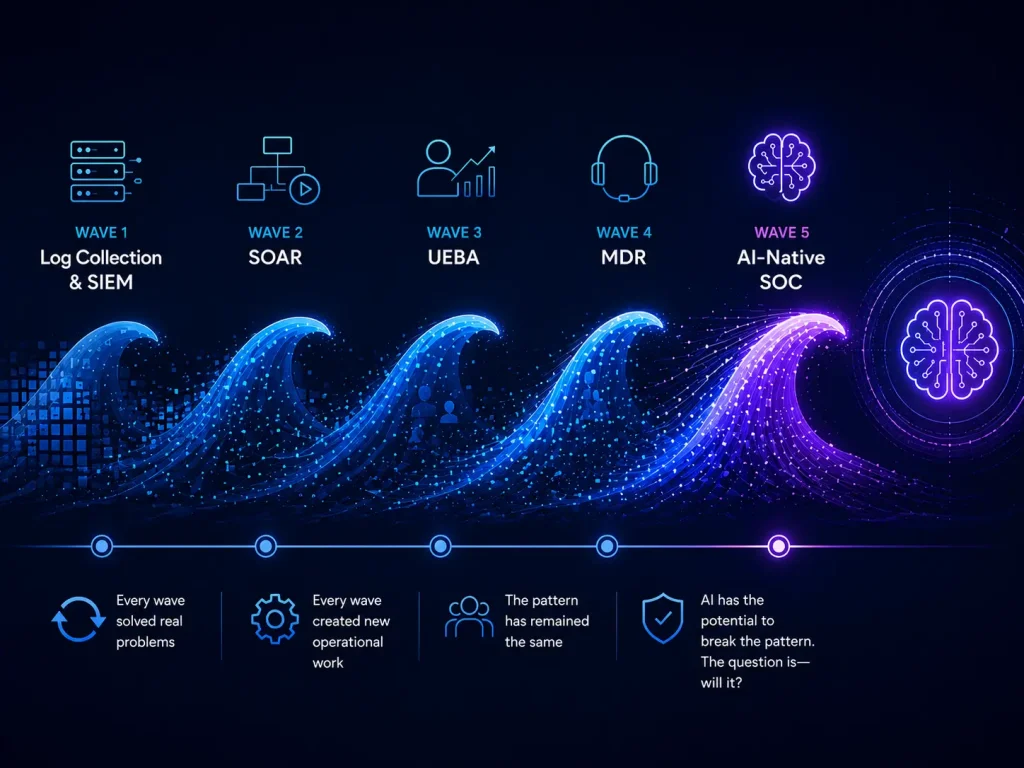
Five Automation Waves in the SOC and The Pattern the AI Wave Has Not Broken Yet
Every wave of security operations automation has promised the same thing: less work and faster response for security teams. Every wave has delivered genuine innovation.…
Read article
The Economics Behind Every AI SOC
AI SOCs promises predictable security outcomes. Faster investigations. Lower analyst workloads. Quicker response. Better resilience. Behind every fixed-price managed service, however, sits a variable that…
Read article