
The Economics Behind Every AI SOC
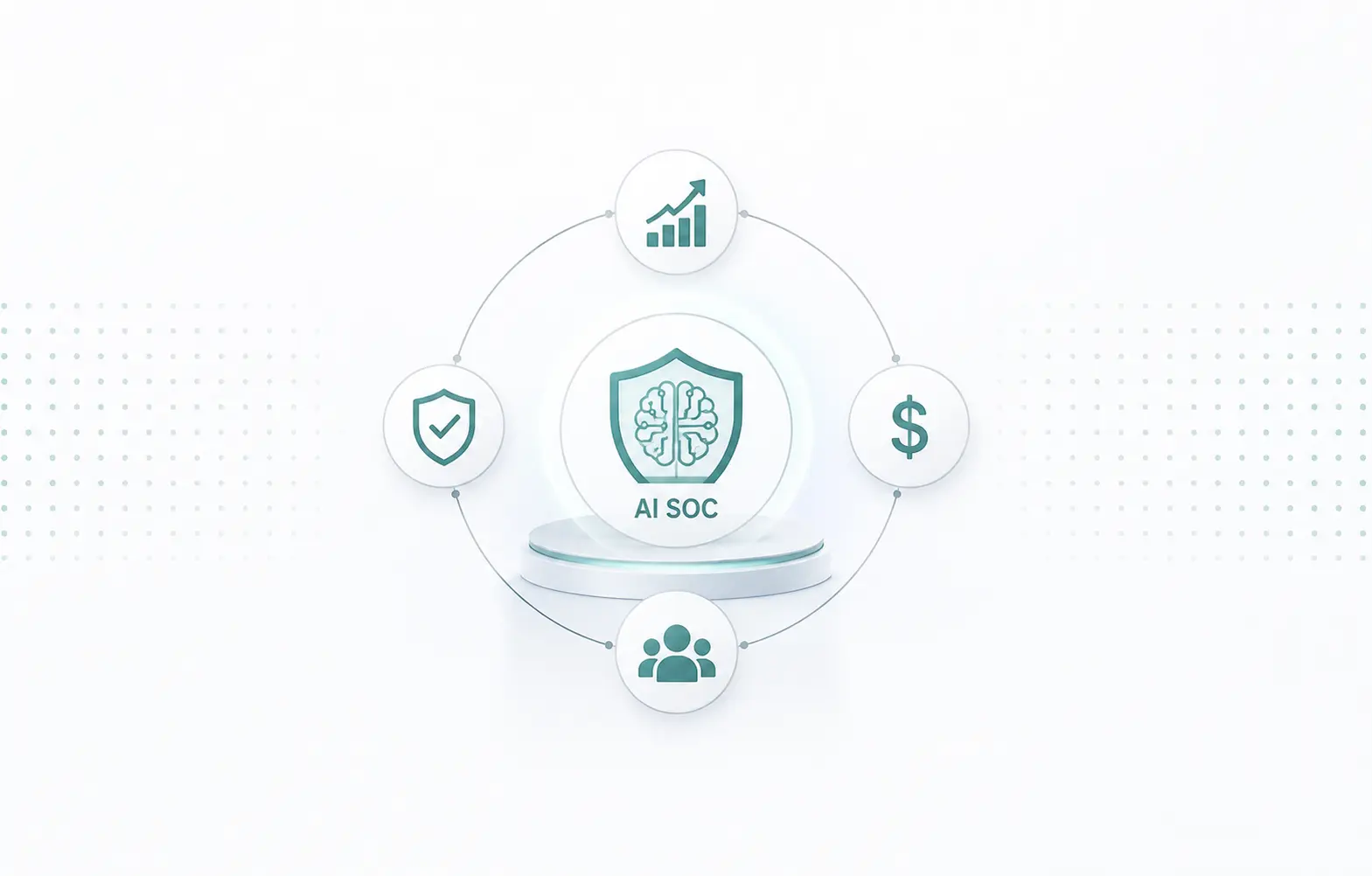
AI SOCs promises predictable security outcomes. Faster investigations. Lower analyst workloads. Quicker response. Better resilience.
Behind every fixed-price managed service, however, sits a variable that few buyers ever ask about: the cost of AI itself.
Today, the economics work. Frontier language models continue to improve, inference costs have generally trended downward over time, and vendors have been able to build compelling managed services on top of them.
But none of that is guaranteed.
If you’re a Nordic bank, a listed utility, or a global manufacturer signing a three-year managed SOC agreement, one question deserves far more attention than it currently receives:
What happens if the economics of frontier AI change?
AI Has Introduced a New Supply Chain into Cybersecurity
Traditional managed security services depended on people, processes and infrastructure.
AI-native security operations introduce a different dependency stack.
They rely on external AI providers, inference infrastructure, GPU availability, model release cycles, API capacity, regional hosting options and evolving regulatory requirements. Those dependencies sit beneath every investigation, every recommendation and every automated response.
For most buyers, they’re almost invisible.
But they influence the long-term economics and resilience of every AI SOC platform.
The Economic Shape of an AI SOC
An AI SOC has an unusual cost structure.
Its primary variable cost is inference.
Every alert rarely triggers a single AI request. Instead, it passes through a sequence of reasoning steps:
- Normalisation
- Correlation
- Threat hypothesis generation
- Evidence validation
- MITRE mapping
- Response recommendation
- Investigation summary
- Report generation
Much of that pipeline can run efficiently on lightweight models or deterministic code. But the reasoning layer—the part that decides whether a suspicious login represents legitimate travel or the first stage of an intrusion—is computationally expensive.
Now consider scale.
A mid-sized enterprise may generate tens of thousands of alerts every day.
Each investigation consumes multiple reasoning stages.
Inference quickly becomes one of the largest operating costs of delivering an AI-native SOC.
Meanwhile, customer pricing usually remains fixed.
Whether priced per endpoint, per user or as a managed outcome, customers expect predictable monthly costs.
That leaves the vendor operating between a fixed-price customer contract and a variable-cost AI supplier.
As long as inference costs remain stable, the model works well.
But what happens if they don’t?
Four Ways the Economics Can Change
- Model pricing changes
Enterprise AI pricing has already evolved several times.
Reasoning-focused models cost significantly more than lightweight models, and the industry is steadily moving toward more sophisticated reasoning because that is precisely what customers value.
The assumption that costs will always decline is optimistic rather than guaranteed.
- Model performance improves
Suppose next year’s frontier model delivers dramatically better investigations.
Customers will naturally expect vendors to use it.
If vendors don’t adopt it, they risk falling behind.
If they do adopt it, operating costs may increase significantly.
Better AI doesn’t always mean cheaper AI.
- Platform availability changes
API rate limits evolve.
Capacity guarantees are negotiated rather than permanent.
Models are retired.
New versions require prompt redesign, evaluation, testing and pipeline optimisation.
None of those costs appear on an inference invoice, but they represent real engineering investment that directly affects service delivery.
- Geopolitics reshapes AI infrastructure
Today’s frontier AI ecosystem is concentrated among a relatively small number of providers.
European security providers therefore inherit broader geopolitical dependencies around data residency, export controls, infrastructure concentration and evolving regulatory expectations.
Even organisations with strong sovereignty requirements may ultimately depend on AI infrastructure beyond their direct control.
None of these scenarios are catastrophic.
But each should form part of a buyer’s due diligence.
Why Security Is Different
Many AI products can absorb changing AI economics.
A productivity assistant might reduce usage, introduce premium features or accept slightly higher response times.
A managed SOC cannot.
Security operations are governed by service levels, response commitments and customer expectations.
You cannot investigate only half of a ransomware precursor because inference has become expensive.
You cannot delay incident reasoning because API capacity is constrained.
The reasoning itself is the product.
That makes economic resilience just as important as model intelligence.
What Buyers Should Really Ask
Rather than asking whether a vendor uses AI, buyers should ask how resilient that AI platform is.
Questions worth asking include:
- Can the investigation pipeline operate across multiple AI providers?
- How much of the workflow depends on expensive frontier reasoning models?
- Which parts of the investigation are deterministic rather than AI-driven?
- Can the platform run within sovereign or dedicated environments if required?
- Would customers experience pricing or service changes if inference economics shifted?
These questions reveal far more about a platform’s long-term viability than a discussion about model names.
Designing for Economic Resilience
The strongest AI SOC platforms are likely to share several architectural characteristics.
They separate deterministic workflows from reasoning tasks.
They reserve expensive reasoning only for investigations that genuinely require it.
They remain portable across multiple model providers rather than depending on a single ecosystem.
They support sovereign, dedicated or on-premises deployments where operational or regulatory requirements demand them.
Most importantly, they protect customers from fluctuations in the underlying AI market rather than passing those risks directly into service pricing.
Where Vokter Fits
Vokter is delivered as a managed security outcome rather than a token-based AI service. Its investigation pipeline is designed to be model-portable, uses tiered inference to reserve advanced reasoning for the most complex investigations, combines deterministic automation with AI-driven analysis, and supports EU-hosted as well as dedicated deployment models where required.
That approach is about more than compliance.
It is about ensuring that changes in the AI landscape do not become changes in the customer’s security operations.
The Next Competitive Advantage
The first generation of AI SOC platforms will compete on investigation quality.
The next generation will compete on resilience.
Not simply resilience against cyber-attacks.
Resilience against changes in the AI ecosystem itself.
The question for buyers will no longer be whether a vendor uses AI.
It will be whether that platform can continue delivering the same security outcomes if AI pricing, infrastructure or availability changes tomorrow.
Those architectural decisions may ultimately prove just as important as the intelligence of the models themselves.
More insights

The Tempo of Modern Security Operations
What’s inside Security operations are no longer defined simply by how many alerts a team handles or how many tools it runs. They are increasingly…
Read article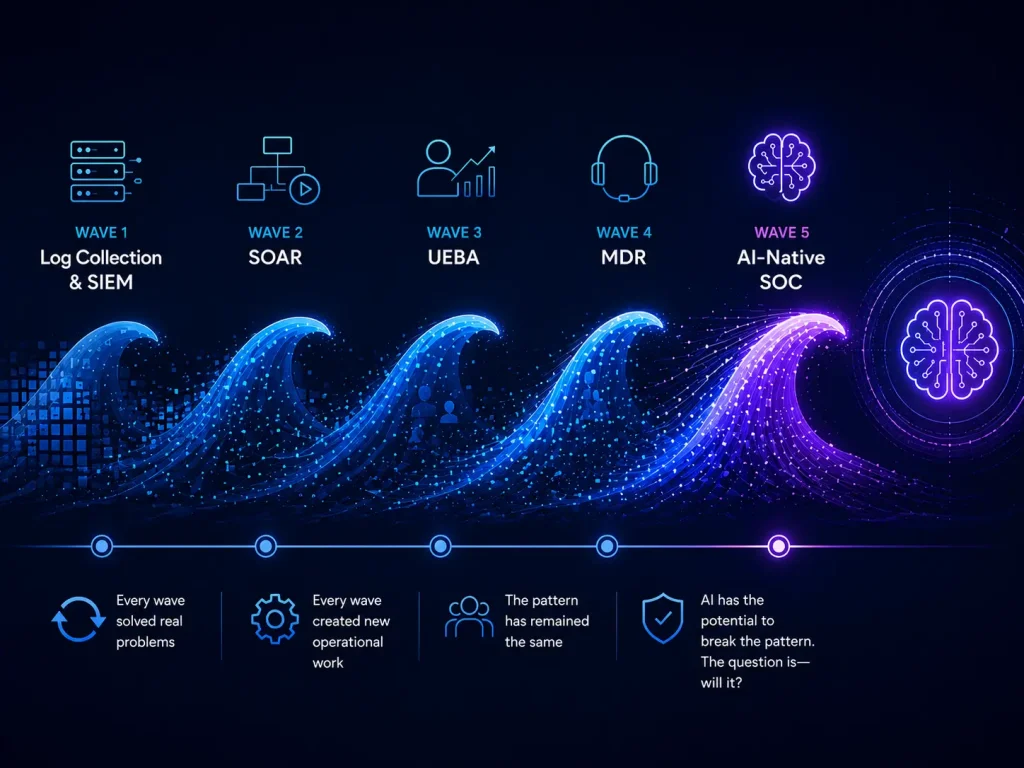
Five Automation Waves in the SOC and The Pattern the AI Wave Has Not Broken Yet
Every wave of security operations automation has promised the same thing: less work and faster response for security teams. Every wave has delivered genuine innovation.…
Read article
The Cybersecurity Industry Is Suffering from Feature Inflation
For decades, cybersecurity has been defined by innovation. Every major wave of technology addressed a genuine gap in enterprise defense. Firewalls secured networks. Endpoint protection…
Read article