
The Operating System for Modern Security

For most of the past twenty years, cybersecurity innovation has followed a familiar pattern.
When organisations became connected, we built firewalls.
When endpoints became the primary attack surface, we built EDR.
As cloud adoption accelerated, we introduced CASB, CSPM and CNAPP. As identities became the new perimeter, identity protection evolved into a discipline of its own. We built SIEMs to centralise telemetry, SOAR platforms to orchestrate response, XDR to correlate signals, and threat intelligence platforms to enrich investigations.
Each innovation solved a genuine problem.
Each became an essential part of the modern security stack.
Today, most organisations already possess capable security technologies. Detection capabilities have matured significantly. Security teams can identify malicious activity faster and with greater accuracy than ever before.
Yet something still feels fundamentally broken.
Security operations continue to struggle under growing workloads. Analysts remain overwhelmed. Mean Time to Respond remains stubbornly high. Organisations continue to invest in new security technologies, yet operational efficiency often improves only marginally.
The obvious question is: Why?
The answer isn’t another detection gap.
It is an execution gap.
Every Generation of Technology Eventually Needs an Operating Layer
History tends to repeat itself.
Enterprise software did not become transformative simply because organisations accumulated more applications. It became transformative when those applications were connected through workflow engines, automation platforms and orchestration.
Cloud computing did not fundamentally change infrastructure because virtual machines were faster. It changed because infrastructure became programmable.
Software engineering did not accelerate because developers wrote code more quickly. It accelerated because CI/CD pipelines transformed how software moved from development to production.
Every mature technology ecosystem eventually develops an operational layer.
Cybersecurity is now approaching the same point.
The Modern Security Stack Is Rich in Capability, but Fragmented in Execution
Most organisations already operate an impressive collection of security technologies.
- Endpoint protection detects suspicious behaviour.
- Identity platforms identify abnormal access.
- Threat intelligence adds external context.
- Cloud security tools monitor infrastructure.
- SIEM platforms aggregate events across environments.
Each system performs its intended function exceptionally well.
The challenge begins when an alert appears. Detection is only the starting point of an investigation. From that moment onwards, security operations become a sequence of decisions.
- What actually happened?
- Is this activity legitimate?
- Which user is involved?
- Which assets are affected?
- Has this behaviour appeared before?
- What policy applies?
- Can the incident be contained automatically?
- Should it be escalated?
- How should it be documented?
None of these questions are answered by a single security product. They are answered through operations.
Security Has Become an Operational Discipline
This represents a subtle but significant shift.
For years, cybersecurity was viewed primarily as a technology problem. Today, it is increasingly an operations problem.
Modern organisations are generating more telemetry than humans can realistically process. Hybrid work, cloud-native applications, machine identities, SaaS platforms and AI-assisted development have all increased operational complexity.
- The issue is no longer visibility. It is consistency.
- Can every investigation follow the same disciplined process?
- Can routine decisions be executed without delay?
- Can every action be documented automatically?
- Can analysts spend their expertise where it creates the greatest value rather than repeating the same investigative workflow hundreds of times each week?
The Next Architectural Shift
Every major shift in cybersecurity architecture has introduced a new layer.
- Firewalls introduced perimeter defence.
- EDR introduced endpoint visibility.
- XDR introduced cross-domain correlation.
The next layer will not replace any of these technologies. Instead, it will sit above them.
An operational layer.
One that continuously gathers context, reasons across multiple sources, validates policies, orchestrates responses, documents investigations and determines when human judgement is genuinely required.
Not another dashboard. Not another source of alerts. A system responsible for moving investigations from signal to outcome.
What the Future Looks Like
The future security team will not necessarily be larger. Nor will it rely on dramatically different security products. Instead, it will operate differently.
- Routine investigations will execute automatically within governed policies.
- Human analysts will focus on exceptions rather than repetition.
- Documentation will be created as part of the workflow rather than after the fact.
- Every decision will be transparent, auditable and repeatable.
Security operations will become less dependent on individual effort and more dependent on operational intelligence.
A New Way to Think About Security Operations
Every mature technology industry eventually reaches a point where adding another tool produces diminishing returns.
The next leap forward comes from improving how the entire system operates. Cybersecurity is reaching that point now.
We believe the future belongs to organisations that treat security not as a collection of products, but as an operational system, one where intelligence, automation and human expertise work together seamlessly.
That belief is what led us to build Vokter.
Not as another security platform. But as the operating layer for modern security operations.
More insights

The Tempo of Modern Security Operations
What’s inside Security operations are no longer defined simply by how many alerts a team handles or how many tools it runs. They are increasingly…
Read article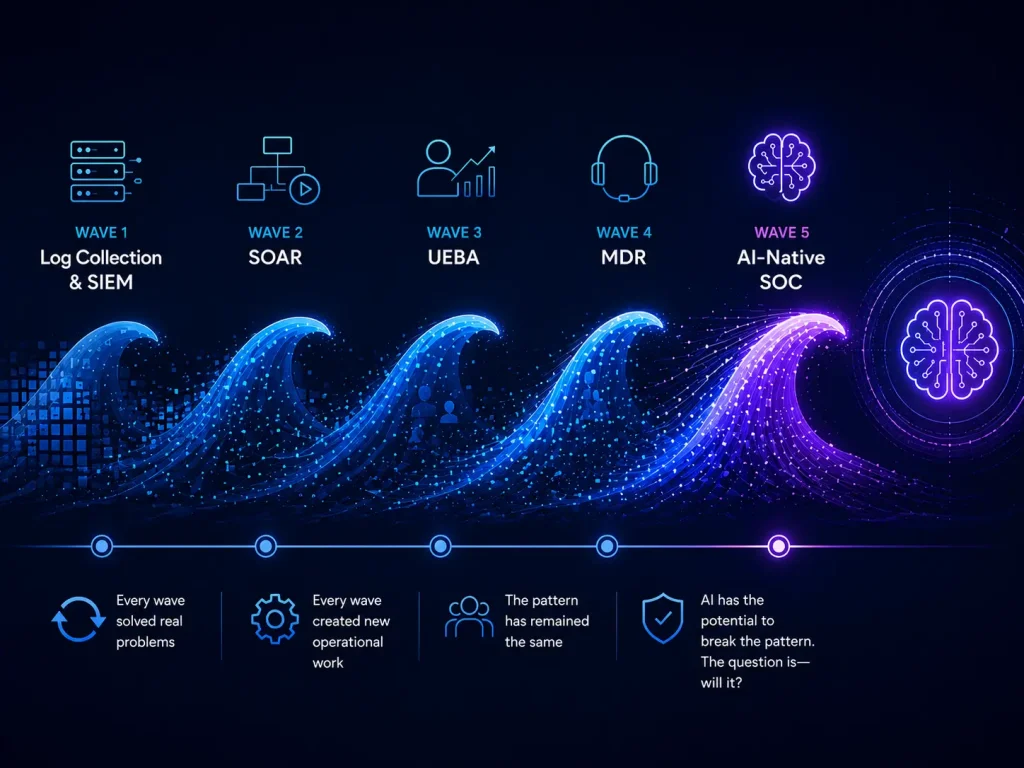
Five Automation Waves in the SOC and The Pattern the AI Wave Has Not Broken Yet
Every wave of security operations automation has promised the same thing: less work and faster response for security teams. Every wave has delivered genuine innovation.…
Read article
The Economics Behind Every AI SOC
AI SOCs promises predictable security outcomes. Faster investigations. Lower analyst workloads. Quicker response. Better resilience. Behind every fixed-price managed service, however, sits a variable that…
Read article