
AI-Native vs AI-Powered: Where the AI Sits Decides Everything
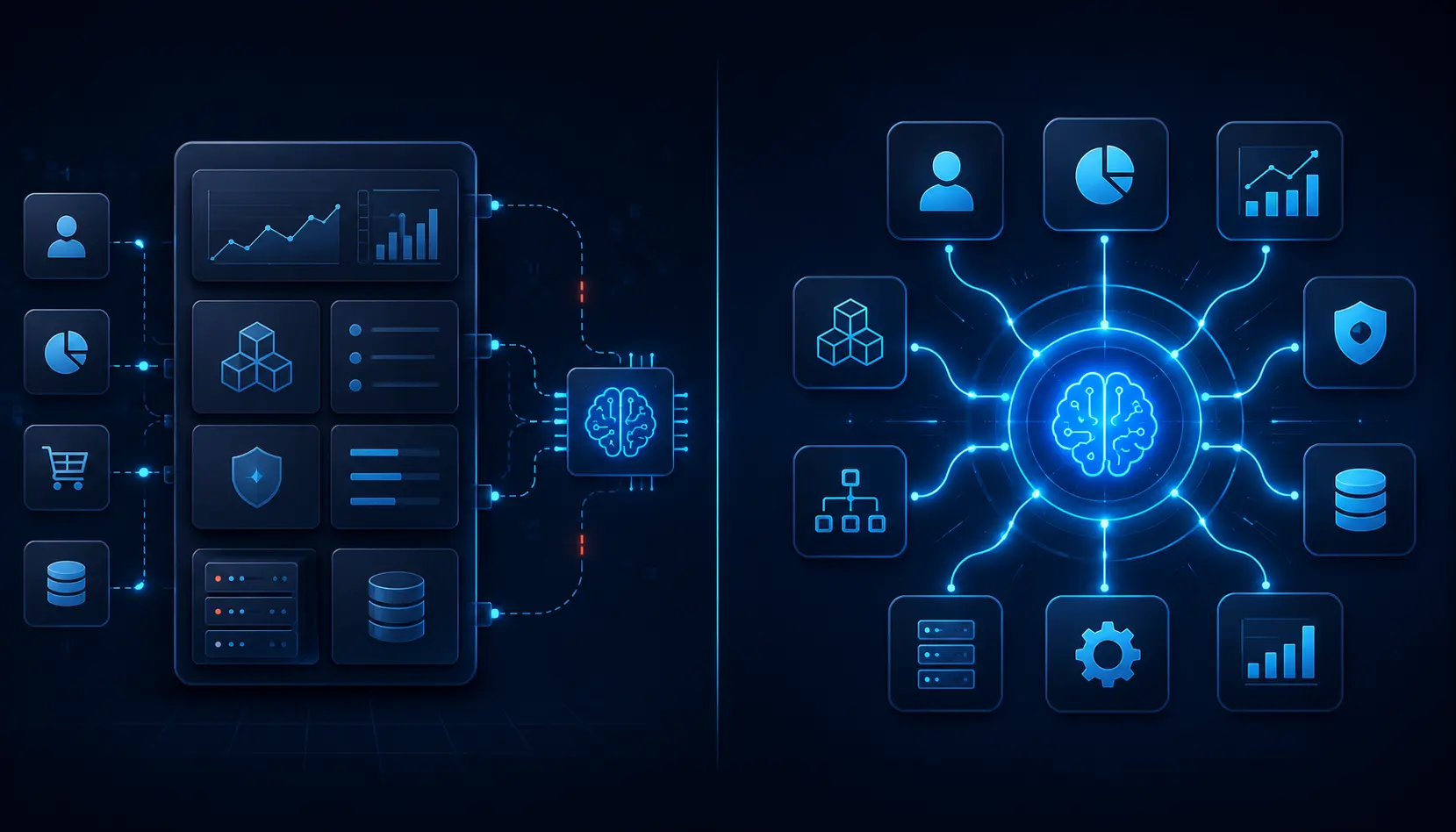
Every security vendor now says “AI”, which has made the word almost useless for telling products apart. The useful distinction is not hype versus substance plenty of the AI is real, but where the AI sits in the control flow. Answer that, and you can predict whether a platform will actually remove your Level 1 workload or merely give your analysts a faster way to do the same work.
Key takeaways
- “AI-powered” keeps a human as the scheduler: the analyst decides what the AI works on next, so throughput stays bounded by human attention.
- “AI-native” makes the system hold the loop: alerts drive the work, the AI runs triage-to-verdict, and humans are called as a subroutine for judgement.
- Only the native model removes the L1 queue; retrofits hit a throughput ceiling because the queue still reaches humans.
- Native is not autonomy-without-oversight done right it pairs machine-speed operations with guardrails, explainability and human-on-the-loop control.
It is not hype vs substance
It is tempting to read “AI-native” as the honest option and “AI-powered” as marketing. That is the wrong frame. An AI copilot that summarises a case or drafts a query is genuinely useful and genuinely AI. The difference that matters is structural, and it is easy to miss precisely because both products demo well: one helps a person do a task faster, the other changes who is doing the task at all.
Where the AI sits in the control flow
Think about the unit of work. In an AI-powered tool, the unit is still “an analyst opens a ticket and invokes the AI.” The human is the scheduler nothing happens until a person decides to look. Total throughput is therefore capped by how many tickets humans can attend to, no matter how fast each one now goes. In an AI-native platform, the unit of work is “an alert arrives and the system runs the loop”: ingest, enrich, correlate, reach a verdict, resolve or contain the clear cases, and escalate the rest. The human is not the scheduler; the human is a subroutine the system calls when judgement is required. That inversion is the whole game.
It also changes what “context” means. An assistant is effectively stateless it answers the prompt in front of it. A native system maintains investigative state across signals and over time, so three related weak signals become one strong case instead of three separately-dismissed alerts.
The 3am test
Here is a single question that separates the two in practice: what happens at 3am with no analyst logged in? An AI-powered tool stalls the AI is a capability waiting to be invoked, and there is no one to invoke it, so alerts queue until morning. An AI-native platform runs the same at 3am as at 3pm, because the alerts themselves drive the work. If a vendor’s “autonomy” depends on an analyst being present to press go, it is powered, whatever the datasheet says.
Why retrofits plateau
This is why bolting AI onto a legacy SIEM or a human-heavy MDR produces diminishing returns. The workflow underneath was designed around a human queue; adding AI shortens the time spent per ticket but does nothing about the number of tickets that still land in front of a person. You get a real but bounded improvement and then a ceiling — a practical echo of Amdahl’s law, where speeding up one stage cannot fix a pipeline still gated by an unautomated one. To remove the ceiling you have to remove the queue, and that is an architectural decision made at the foundation, not a feature added later. We walk through the broader shift in AI SOC vs traditional SOC.
AI-powered vs AI-native, side by side
| Dimension | AI-powered | AI-native |
|---|---|---|
| Unit of work | Analyst opens ticket, invokes AI | Alert arrives, system runs the loop |
| Who schedules the work | The human | The system; human is called for judgement |
| Throughput ceiling | Bounded by analyst attention | Bounded by compute, not headcount |
| State across signals | Stateless per prompt | Persistent case context |
| At 3am, no analyst | Queues until morning | Runs unchanged |
| Effect on L1 queue | Cleared faster | Largely removed |
| Right role | Analyst accelerator | Operating layer |
The honest risks of going native
Native is not a free lunch, and anyone who sells it as one is worth distrusting. Handing the loop to a system raises real questions: how are its verdicts explained and audited; can every automated action be reversed; what stops it acting on a bad correlation; how is model drift detected; and where exactly is the human sign-off for disruptive steps? The answer is not “trust the AI” it is guardrails, reversibility, human-on-the-loop control for consequential actions, and full auditability of decisions. Handled well, governance is what makes machine-speed operations trustworthy rather than what slows them down; it is also increasingly a compliance expectation under the EU AI Act’s transparency obligations. A native platform that cannot explain a verdict is not more advanced it is less safe.
How to evaluate a claim
Cut through the language with control-flow questions: What runs with no human in the loop? Does an escalation arrive as a finished investigation or a forwarded alert? Is case state maintained across signals, or is each prompt fresh? Can I sample and audit auto-resolved cases? Can every automated action be reversed, and who signs off on the disruptive ones? Our provider evaluation guide expands these into a full checklist.
AI-native operations with Vokter
Vokter is AI-native by construction: alerts drive the loop, the system runs triage-to-verdict and safe first-line response, and your team is called in for the decisions that need judgement with guardrails, reversible actions and auditable verdicts throughout. Deploy it standalone with Vokter Autonomous, over your existing stack with Vokter Hybrid, or with named Nordic analysts and an SLA via Vokter Guardian all operated within EU jurisdiction. Put it to the 3am test on your own alerts.
Frequently asked questions
What is the real difference between AI-powered and AI-native security?
Does AI-native mean there is no human oversight?
Can a legacy SIEM or MDR become AI-native by adding AI features?
Are AI-powered security tools worth using?
What is the 3am test for AI security platforms?
More insights

The Tempo of Modern Security Operations
What’s inside Security operations are no longer defined simply by how many alerts a team handles or how many tools it runs. They are increasingly…
Read article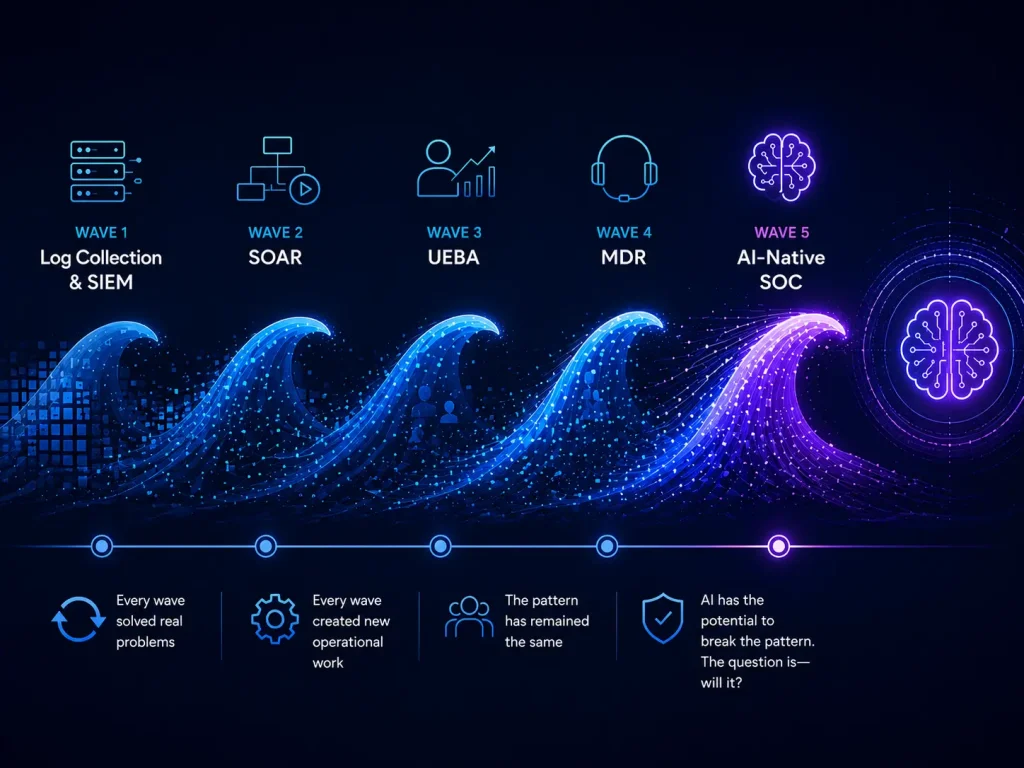
Five Automation Waves in the SOC and The Pattern the AI Wave Has Not Broken Yet
Every wave of security operations automation has promised the same thing: less work and faster response for security teams. Every wave has delivered genuine innovation.…
Read article
The Economics Behind Every AI SOC
AI SOCs promises predictable security outcomes. Faster investigations. Lower analyst workloads. Quicker response. Better resilience. Behind every fixed-price managed service, however, sits a variable that…
Read article